


In a nutshell: Reducing emissions is a priority that is becoming increasingly important for many countries and industries, and the IT sector is no exception. This guide covers: The benefits of Green IT practices from a business perspective, reducing operating costs, mitigating risks, and an opportunity to stand out from the competition.
Emissions reduction is a growing priority for many countries and industries, and the IT sector is no exception.
This article will highlight the role of Green IT not only in creating sustainable web and mobile applications but also in the success of businesses that must ingeniously address ecological challenges to maintain relevance and improve efficiency across various levels.

What is Green IT?
Green IT (green computing) refers to more environmentally friendly IT practices, primarily aimed at minimizing the energy consumption of our digital tools and software.
To delve deeper, digital technology can be utilized in two ways:
- On-premises, local usage of your computers and servers.
- The use of web services and “cloud” services, which operate using remote servers.
While all digitized content may appear significantly less polluting than tangible products, numerous studies demonstrate the extent to which the digital world contributes to GHG emissions—a contribution that is far from negligible!
According to a study by Frédéric Bourdage, an expert in digital sobriety and founder of GreenIT.fr, it is estimated that the carbon footprint associated with digital activities accounts for approximately 5% of total global emissions, equivalent to about 2 gigatons of CO2.
According to the preliminary report from the Senate's information mission on the environmental footprint of digital technology, digital GHG emissions could significantly increase if no action is taken to reduce their footprint: +60% by 2040, representing 6.7% of national GHG emissions.
Digital emissions are distributed as follows (according to a study by the Green IT Think Tank):
- User equipment (66%)
- Networks (19%)
- Data centers (15%)
In software development, Green IT focuses on reducing emissions by alleviating loads on networks and data centers.
Core Principles of Green IT in Software Development
In practice, Green IT in 2024 typically involves the following strategies:
Efficient Code Writing
One of the primary components of Green IT is energy-efficient code writing, minimizing the resources required to execute software applications.
By optimizing algorithms and reducing computational complexity, developers can create a digital product that consumes less energy and generates less heat, thereby contributing to a lower carbon footprint.
Furthermore, minimizing memory-intensive processes and eliminating redundant code can further enhance energy efficiency.

Minimizing On-Premise Infrastructure
Cloud service providers often possess highly optimized infrastructure for energy consumption.
By migrating to cloud-based services, businesses can minimize their internal infrastructure requirements while benefiting from energy efficiency and sustainable practices.
This not only minimizes the costs and complexity associated with infrastructure management but also allows for the utilization of these data centers' energy efficiency and sustainable practices. For example, our partner DRI provides eco-responsible web hosting through its innovative ecological data center in France, which features a PUE of 1.15.
Automated Testing / Green IT Testing
Testing tools are another eco-friendly practice that is not only environmentally friendly in and of itself—by identifying bugs as efficiently as possible—but can also help identify areas where your software solutions can be improved from an environmental perspective through Green IT automated testing.
Automated testing offers several benefits in terms of digital sustainability:
Product Lifecycle Optimization: By detecting and correcting bugs more rapidly, organizations reduce the resource waste associated with defect remediation at advanced stages of development.
Reduction of Carbon Emissions: Manual testing necessitates extensive hardware and energy infrastructure. Test automation allows companies to significantly reduce their energy consumption and, consequently, their carbon emissions.
Assessment of Your Development Practices and Software to Identify Areas for Improvement: Regular Green IT testing can provide essential insights into the current state of your digital infrastructure and the success of Green IT initiatives, enabling strategy refinement over time.
Green IT Monitoring
Green ITmonitoring involves conducting Green IT tests on an ongoing basis. Tracking the digital footprint over time allows organizations to remain constantly aware of areas that can be improved at any time.
This enables the achievement of more favorable results by preventing ecologically inefficient updates and ensuring that problems are identified before they cause significant damage.
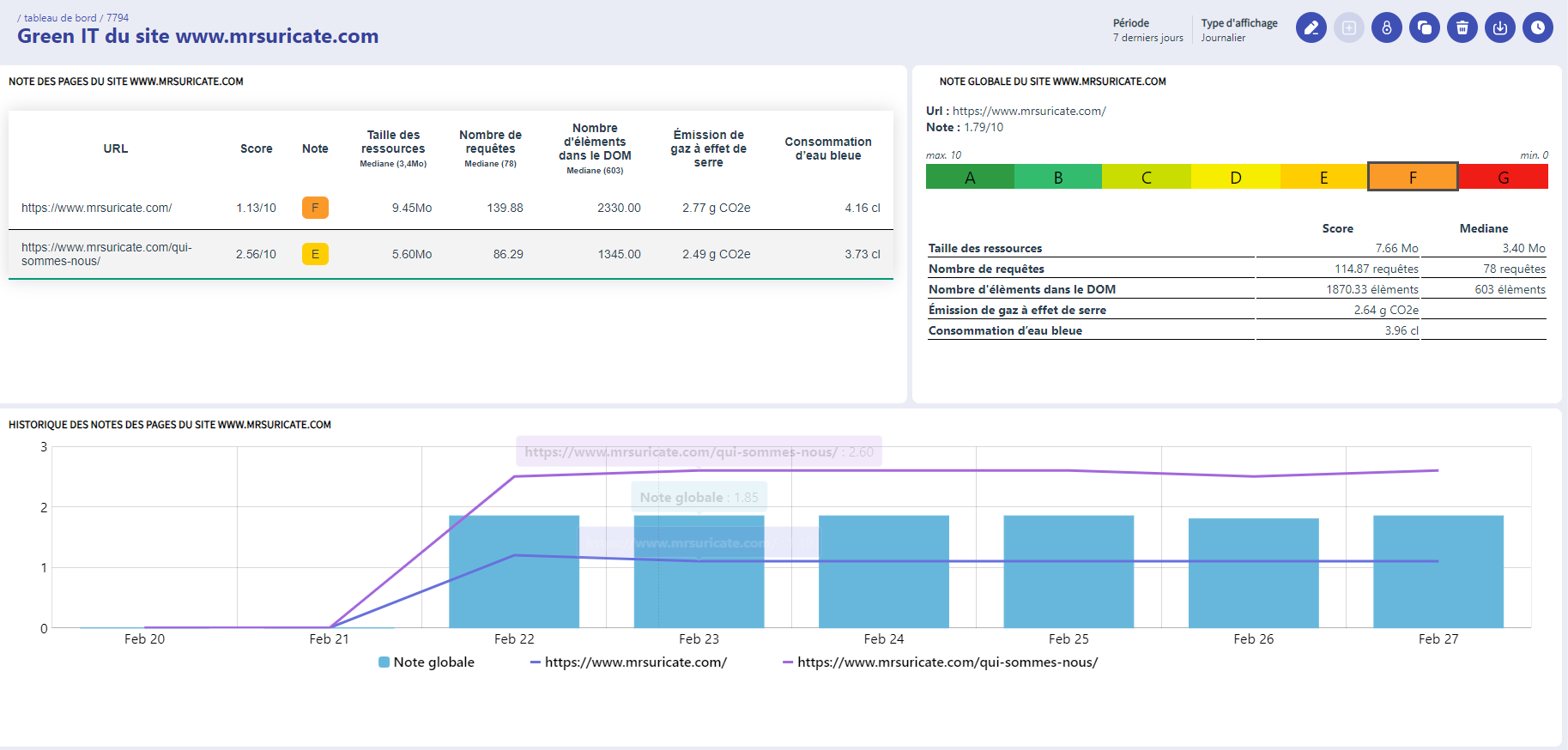
For example, at Mr Suricate, Green IT monitoring provides you with the following key KPIs:
- Resource size
- Number of requests
- Number of elements in the DOM
- Greenhouse gas emissions
- Water consumption
Benefits of Green IT Practices from a Business Perspective
Adopting Green IT is not only beneficial for the environment but also for several aspects of businesses:
Operational Cost Reduction
Companies can significantly reduce their energy consumption and associated costs by adopting a greener infrastructure.
According to a study conducted by Boavizta, an association dedicated to assessing the environmental impacts of digital technology, among organizations that realize savings through Green IT practices, one in three cites reduced IT purchases, and less than one in four cites reduced energy bills.
In the study, video game publisher Ubisoft cites potential savings of “more than 1 M€ per year by putting workstations into sleep mode and extending the lifespan of equipment.”
Risk Mitigation
Adhering to sustainable practices helps businesses comply with environmental regulations and avoid potential fines or legal issues.
This also reduces the likelihood of negative publicity…
An Opportunity to Differentiate from the Competition
By adopting sustainable practices associated with Green IT, companies can position themselves as key players in the ecological industry, fostering a positive image that attracts clients and partners who increasingly prioritize eco-responsibility.
One way to promote Green IT initiatives is through case studies and success stories highlighting the tangible environmental benefits of completed projects.
An Efficiency-Centric Development Process
Sustainable practices stimulate innovation as companies seek new ways to optimize processes and reduce waste, inevitably leading to the development of more efficient software solutions.
Mr Suricate France's leading provider of no-code automated testing
By reducing resource consumption, optimizing product lifecycles, and decreasing carbon emissions through Green IT strategies and practices, companies can integrate digital sustainability into their software development practices.
When it comes to Green IT, test automation is an essential practice, and at Mr Suricate, we offer a wide range of automated tests to ensure your acceptance testing is thorough and to provide your users with the best possible experience.
Further Reading
FAQ
What Is Green IT in Software Development?
It refers to all practices aimed at reducing a software's environmental footprint: more efficient code, lower resource consumption, and optimized infrastructure.
What are the benefits of Green IT for businesses?
Reducing operating costs, mitigating risks, differentiating from the competition, and pursuing efficiency-focused growth.
Does Green IT conflict with performance?
No, on the contrary. Simpler software is often faster and less expensive to operate. Efficiency and simplicity go hand in hand.
How does testing contribute to Green IT?
By avoiding waste: run the right tests, focus on the essential user journeys, and optimize test execution rather than testing everything en masse.
How Mr Suricate into a Green IT initiative?
By enabling teams to focus testing on critical workflows and to automate intelligently, ensuring efficient coverage without waste—for both business teams and key accounts.
Learn more: Green IT tests.