









Third-party systems includedWeb, Mobile, and APIsWithout writing any code

End-to-End Testing: The Complete Journey, All the Way to the Back Office

A customer places an order, the order is processed in the ERP system, inventory is adjusted, and a confirmation email is sent. The end-to-end test verifies the entire process, including systems you didn't develop.

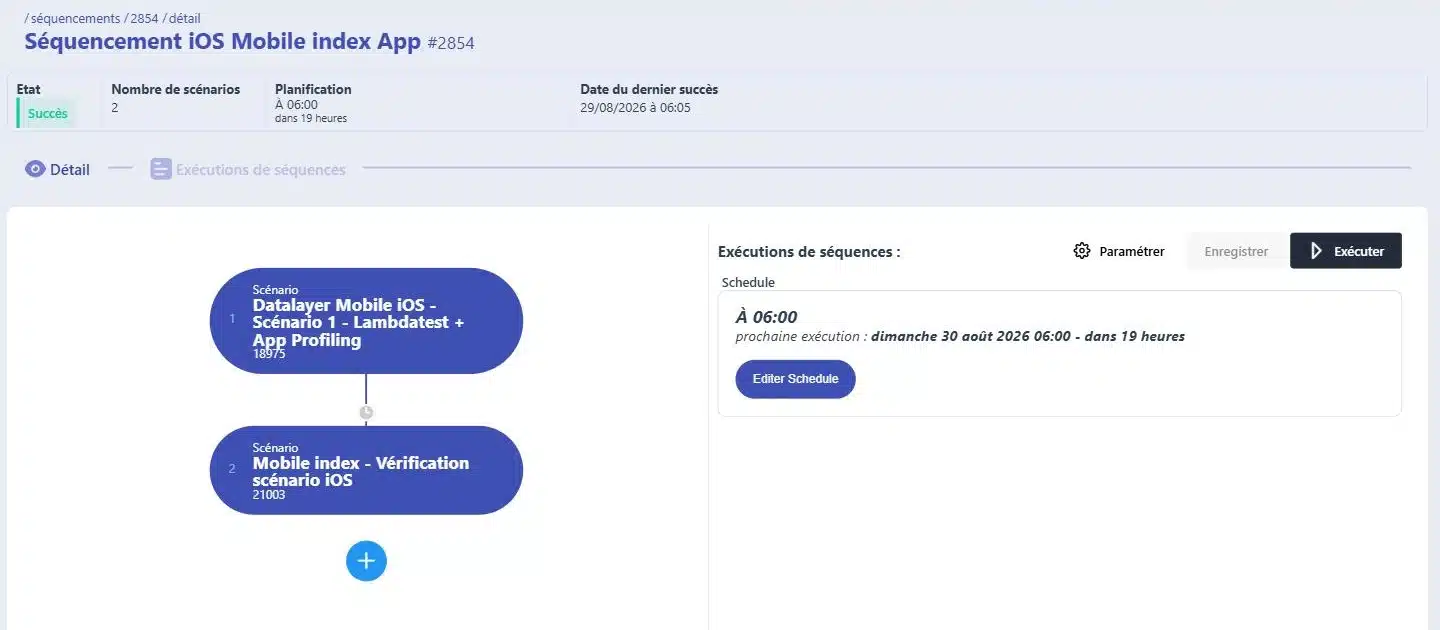
Sequencing Scenarios in " Mr Suricate ": Two Linked Paths Planned Each Day

They trust us

Retail, banking, manufacturing, transportation, and services: Our clients run nearly 3 million scenario simulations per month on their critical workflows.

Every brick works, and yet the chain breaks

The website works, the ERP system works, and the payment provider works. The problem lies at the interface: a renamed field, a changed date format, or a webhook that’s no longer being received. This issue doesn’t belong to any single team, and no unit test catches it, because it exists only where the systems communicate with each other.

Mouse icon

From the Screen to the Management System

The script doesn't stop at the confirmation page. It verifies that the order has indeed arrived at its intended destination.

Purple Rectangles Icon

ERP, CRM, payment providers, shipping carriers. Their updates disrupt your user experience, and no one warns you about it.

Purple Gear Icon

Email and the document as steps

Receiving a confirmation email, the content of a document, a webhook response. These are steps in the user journey, and therefore steps in the test.

Purple API Test Icon

Web, mobile, and APIs in the same scenario—because the actual user journey moves seamlessly between them without the user even noticing.

Integrates with your pipeline without rewriting it

Your end-to-end workflows are triggered from your CI, run in your production environments, and feed back into where your teams are already working. No retooling required.

1 Triggering Your tools stay in control
  • GitLab
  • Jenkins
  • Microsoft Azure
  • API Call
  • Planning
2 ExecutionMr SuricateYour scripts run on your production environments
  • Web Tour
  • Native iOS and Android Apps
  • Real Mobile Farms
  • APIs and Internal Feeds
3 Restitution The results are delivered right to your workplace
  • Jira
  • Slack
  • SMS
  • Webhook
  • API
And maintenance that stands the test of time
  • Reusable blocksA change updates all scenarios that use it
  • AI-Assisted CorrectionSuggested corrections for scenarios with errors
  • Grouping IncidentsSimilar anomalies are processed only once

What End-to-End Testing Changes, Line by Line

Unit Tests
With an end-to-end test
Each team tests its own scope.
The course is tested from start to finish.
A joint failure belongs to no one.
It is assigned to a specific stage.
A service provider's update goes unnoticed.
The plan fails that very day.
The back office is checked manually from time to time.
It is checked every time it runs.
It takes half a day to reproduce the problem.
The capture and the check are already in place.
We test what we know how to do.
We test what the customer experiences.
ResultThe entire supply chain is verified with every delivery, including third-party systems over which you have no control.
PRACTICAL GUIDE · 2026 EDITIONSoftware Quality and Testing: The Essential GuideThe fundamentals of functional testing, common pitfalls, and a method for building test coverage that stands the test of time.
Download the guide
“Before we started using Mr Suricate’s tools, it took us an entire day to retest all the site’s features after a new version was released. Now, it only takes 10 minutes. In just 10 minutes, with about 40 critical test scenarios in pre-production, we know whether everything is OK or not. For us, that’s the best selling point: the time savings.”

Michael AlimiDOSI, Intersport

Support that ends whenever you want

Mr Suricate replace your QA team—it enhances it. You decide what to handle in-house and what to outsource: creating test scenarios, running them, or maintaining them over time.

  1. 1Identification of critical paths, front-end and back-end
  2. 2Writing Tests Without Code
  3. 3Continuous monitoring and alerts
  4. 4Scenario Maintenance and Development
ResultYou gain broader coverage without increasing your teams’ workload. And if you’d rather delegate everything, QA outsourcing takes over.

YOUR QUESTIONS

Frequently Asked Questions

The most common questions we get about end-to-end testing.

What is the difference between functional testing and end-to-end testing?

A functional test validates a feature within its scope: the shopping cart calculates the correct total. An end-to-end test tracks the user journey beyond the interface, all the way to the systems that receive the data. It’s a matter of scope, not technique.

Can we test a back-office system or an ERP?

Yes, as long as it is accessible via a browser or an API. The script connects to the back office just as an administrator would and verifies that the order, inventory, or customer file are in the expected state.

How do you verify that an email has been received?

Receiving an email becomes a step in the flow, with the ability to control its content. This is useful for order confirmations, activation links, and one-time passwords, which often block the user from continuing through the process.

Aren't end-to-end tests too fragile?

That's their reputation, and it stems from maintenance. The more systems a scenario passes through, the more changes it encounters. Self-healing fixes some of the issues, and reusable blocks prevent the need to correct the same step in fifteen scenarios.

Are dedicated environments necessary?

Not necessarily, but you need dedicated data. A workflow that generates an actual order in a production ERP system must rely on accounts and part numbers set aside for testing. This is the key point to clarify before getting started, even more so than the environment itself.

What distinguishes an end-to-end test from a functional test?

The scope. A functional test validates a screen or an action. An end-to-end test runs through the entire chain—often spanning multiple applications and systems—until final confirmation. That’s where the failures that no one sees coming lie.

How do you link multiple scenarios together?

Through sequencing: you arrange the scenarios in order; they run sequentially and pass variables to one another. The sequence is planned as a single scenario, and its overall status is tracked in one place.

What happens if an intermediate step fails?

The flow stops or continues depending on the severity level specified for the action group. A group marked as "blocking" interrupts the flow, which prevents the flow from proceeding in an inconsistent state and avoids a cascade of false failures.

Can you pass through multiple environments on a single route?

Yes. Environment management allows you to override data and URLs at launch, so the same sequence can be replayed in the test environment and then in the production environment without being duplicated.

Do you only believe what you see?

A 30-minute demo of your own app. You'll see one of your workflows automated in real time, without writing any code.