










Actual iOS and Android devices·Mobile Web Resolutions·Without writing any code
Your iOS and Android apps tested on actual devices, and your web experiences verified at your users' screen resolutions. Two areas that are often separate, but a single test plan.
An emulator does not replicate the memory of an entry-level phone, the native keyboard that covers the input field, or the version of Android that your customers are still using. The reverse is also true: a website that passes all validation tests on a computer may have its order button off-screen on an iPhone SE, without any tests having caught it.
Your iOS and Android apps are tested on real device farms—not emulators—using your users' OS versions.
The same browser navigation paths replayed at your audience’s screen sizes, revealing where content overflows and unreachable buttons are hidden.
You choose which device and OS combinations to support based on your usage statistics rather than the latest model released.
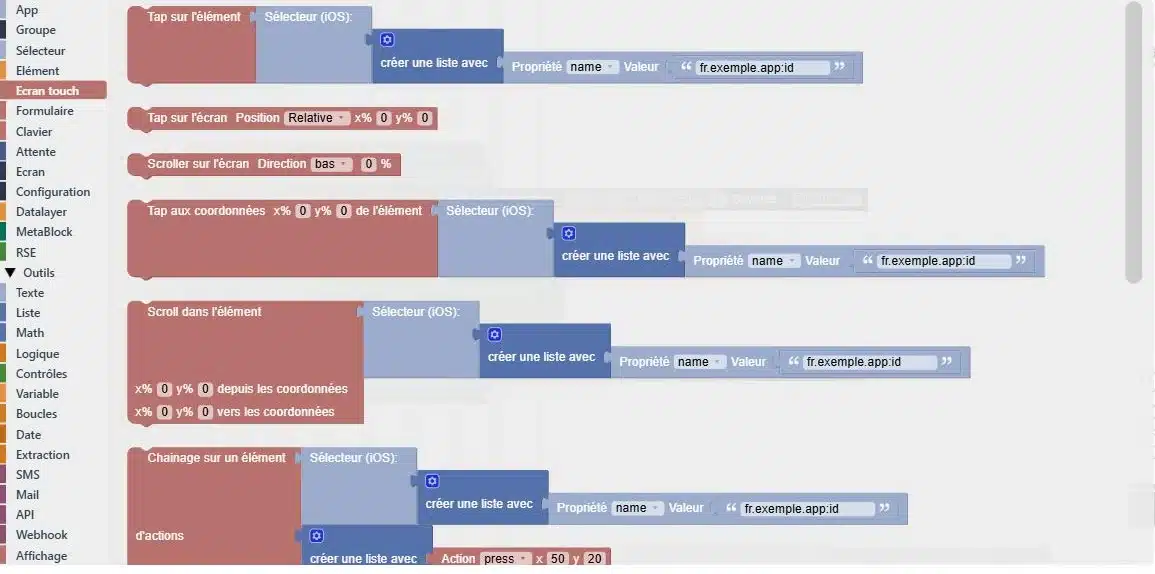
Scrolling, long press, rotation, system back button, resuming after being minimized. These features don't exist on a computer.
“An easy-to-use, fun tool that’s similar to Scratch. The campaign management feature gives me peace of mind before each deployment.”
Coralie Cebron de LisleSoftware Tester, Optivalue
GO FURTHER
Fourteen types of tests, four categories. Each one answers a different question about your application.
Is there a term you don't understand? The automated testing glossary defines it.
YOUR QUESTIONS
The most common questions we get about mobile testing.
Both. iOS and Android apps are run on actual device farms, and your web experiences are also tested at mobile resolutions. These are two distinct areas—often confused with one another—and they are addressed in the same test plan.
On actual devices, not emulators, and across the combinations of device models and OS versions you choose. The right criterion is your own audience breakdown, not the latest device released: it’s often an older model that reveals the flaws.
The two platforms do not have the same components or system actions, so the scenario is tailored to each one. However, the workflow logic and test data are shared, and reusable blocks prevent the need to duplicate everything.
It depends on what you're selling. If your native app generates revenue or provides customer service, it needs to be tested on its own: a validated responsive website says nothing about how the app will behave on a phone that's running other apps, has a weak connection, or receives a notification that interrupts the user experience.
No. Mobile test cases are built just like any others, either through assisted recording or by assembling test blocks. This is what allows a business profile to keep test coverage up to date as the application is released.
A 30-minute demo of your own app. You'll see one of your workflows automated in real time, without writing any code.