









Types of Tests

Load test: Do you know when it fails?

A sales promotion, a TV appearance, or the opening of ticket sales. A stress test simulates the rush before it actually happens, so you know your breaking point instead of finding out in real time.

Gradual ramp-upBreakpoint identifiedOperated by our teams

Mr Suricate -style firing: four successive waves, each a rising tide of executions that lasts one to two minutes before subsiding, followed by a return to calmA shot, step by step100 %75 %50 %25 %0each wave: 1 to 2 minutesLevel 1Level 2Level 3Level 4return to calmStandard time slot: 1 hour14 days' noticeValidation 48 Days Before the Event

They trust us

Retail, banking, manufacturing, transportation, and services: Our clients run nearly 3 million scenario executions per month on their critical workflows. Load testing is a separate service, reserved for those preparing for a peak.

In a nutshell

A load test simulates a surge of concurrent users on a real-world path to determine at what load level performance degrades. This is a service performed by our teams on an agreed-upon date—not a feature that can be launched from the platform—and it measures how the system handles peak loads.

On a busy day, it's too late to take measurements

An infrastructure sized based on averages holds up very well—until the day it no longer does. And what breaks first is almost never what we anticipated: it’s a database overwhelmed by a query from the order processing pipeline, or a third-party service that limits the number of calls. Load testing is specifically designed to uncover that exact sequence of failures, under cold-start conditions.

Mouse icon

The load is generated by your real-world business scenarios, all the way through to payment. A simulated user logs in, searches, adds items to the cart, and places an order—just like a real user.

Purple Rectangles Icon

A Step-by-Step Approach

Each stage is like a wave: the target volume is set all at once; we observe, and then we increase it again. This allows us to identify the point at which performance begins to decline, and then the point at which errors start to appear.

Purple Gear Icon

What Breaks First

Database, third-party service, queue, anti-abuse protection. The report specifies the query that failed and its return code—not a general conclusion.

Purple API Test Icon

A test campaign is planned in advance of a commercial operation, using a representative environment.

What Happens During a Shot

The run is prepared with your teams, executed on our machines, and monitored live with you. You review your own logs as the batch arrives.

  1. 1

    Framing

    You describe the target, the date, and the target thresholds. We verify the architecture, environments, and volumes before confirming. We require 14 days’ notice, and the scope must be finalized 48 hours in advance.

  2. 2

    Shooting, during practice

    On each tier, executions begin in less than ten seconds, and the entire process plays out, all the way through to payment. Your teams are there, monitoring their own logs, as the load comes in.

  3. 3

    The report

    Successful executions by stage, along with the median, minimum, maximum, and 90th percentile times; followed by each failed stage, including the number of occurrences, the screenshot, the return code, and the failed request.

WHAT SHOOTING DOES NOT DO

  • No endurance. We measure the absorption of a peak, not performance over several hours.
  • No performance metrics are collected. During a test, we only collect logs; we do not collect data on downloaded resources or performance metrics.
  • You do not operate it. The firing is carried out by our teams; it is not triggered from the platform.

How the charge shot changes things, line by line

Without a propellant charge
With a charge shot
Sizing is based on an average.
Capacity is determined based on actual volumes received.
On D-Day, we discover the weak link.
This is a known issue, and it has been fixed previously.
The decision to add servers is based on intuition.
It happens on a curve.
The third-party service that limits calls is not expected.
Its limit is shown at the relevant level.
A business deal is a gamble.
We've seen this scenario play out before.
After the incident, no one knows what went wrong.
The report specifies the volume and the stage.
ResultThe volume at which failures begin to occur and the query that fails first—before the business operation rather than after.

Coached shooting

Focus on a template you've filled out
Completion by our teams on the agreed-upon date
Minutes and Summary Report
14 days' notice; scope approved 48 days in advance

Self-service tool

You write the script and provision the machines
You interpret the graphs on your own
No one is signing the minutes

The test run replays the scenarios you already use for your functional testing, performance measurement, and production monitoring. There's no need to write anything new for this.

Load test, critical path, pre-production: See the QA glossary for definitions.

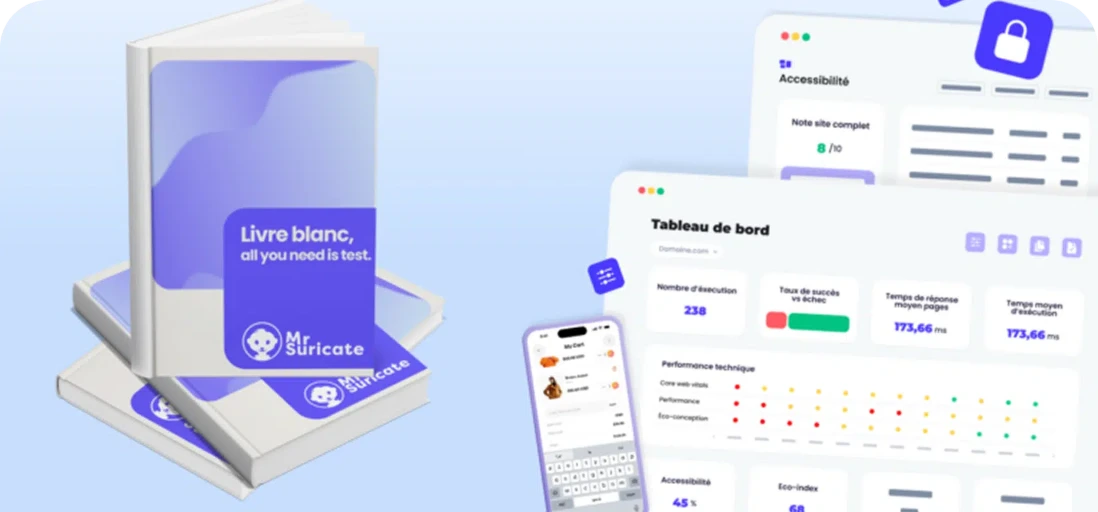
WHITE PAPER · TEST AUTOMATIONWhat if your bugs no longer cost your business anything?The true cost of downtime on a peak day, and the fundamentals to establish before automating.
Download the white paper

A LIVE ROUND

A fashion e-commerce site, two shots in one morning

8Complete purchasing journeys, all the way through to payment
7countries of origin, via proxy, to test the CDN
5,000executions launched simultaneously during the second run

The first round of testing, with 800 runs, showed that response times remained consistent regardless of load or country: the CDN held up. The second test, at 5,000, caused the infrastructure’s safeguards to trigger before the application did, resulting in 429 rejections and 503 errors at the site entrance. This was exactly the threshold the client wanted to determine.

We'll work with you to define the scope; we'll handle the execution.

With Mr Suricate, your QA team isn't replaced—it's strengthened. You choose what to handle in-house and what to outsource: creating test scenarios, running them, or maintaining them over time.

  1. 1Identification of critical paths, front-end and back-end
  2. 2Writing Tests Without Code
  3. 3Continuous monitoring and alerts
  4. 4Scenario Maintenance and Development
ResultYou gain broader coverage without increasing your teams’ workload. And if you’d rather delegate everything, QA outsourcing takes over.

YOUR QUESTIONS

Frequently Asked Questions

The most common questions we get about load shooting.

How is this different from a performance test?

The performance test measures the response time of a workflow under normal, continuous usage conditions. The load test pushes the system to its limits by simulating a massive influx of simultaneous users over a short period of time. One monitors performance, while the other determines system capacity.

Who takes the charge shot?

Our Teams. Load testing is a service we provide—not a feature you simply launch from the platform: we prepare the test scenarios, calibrate the load levels, launch the campaign on the date agreed upon with you, and report the failure point along with the component that fails first.

Can you outsource your load testing?

That’s exactly how it works: our team handles the load testing. You don’t install or manage any load testing tools, nor do you provision any servers. We work with you to define the scope, carry out the testing during an agreed-upon time slot, and provide you with a report followed by a debriefing. Load testing vendors, on the other hand, sell you a tool that your teams must learn to use and operate.

Which environment should we target?

In a production-representative environment; otherwise, the resulting figure is meaningless. In practice, several of our clients run tests directly in production, during an agreed-upon time slot and after notifying the hosting provider. Running tests on an under-resourced pre-production environment yields a conservative failure point, while running tests in production requires strict precautions regarding the data used.

How many concurrent users can be simulated?

We’ve already launched 5,000 simultaneous requests on the same test run. Once the number exceeds a few hundred, it’s often the infrastructure’s safeguards that respond first—with 429 errors or CDN errors—before the application itself. That’s precisely the threshold this test is designed to determine. The volume is therefore based on your historical peak and your target factor, and a gradual ramp-up is offered by default to determine the limit without sending everything at once.

How can you tell if it's the app or its security features that have failed?

This is a distinction that the report explicitly makes, and it changes the conclusion. Beyond a few hundred concurrent sessions, it is often the safeguards that kick in: a 429 rate-limiting code or a 503 error returned by the CDN. It isn’t your application that failed—it’s your safeguards that worked. The report lists the request, its status code, and the stage of the request flow, which makes it possible to distinguish between the two.

Can we test how well it holds up over several hours?

No, and we make that clear before providing a quote, rather than after the first run. A test run lasts one to two minutes and is not automatically restarted: we’re measuring the system’s ability to handle a peak load, not its endurance over time. If you need the system to maintain performance for several hours with a constant workload, you’ll need a query injection tool, not a replay of business processes.

What happens during a shooting?

In waves. At a given stage, all takes are completed in less than ten seconds, and each take takes one to two minutes, until payment is made. We observe, then move on to the next stage. A shoot takes up a one-hour time slot, which covers setup, the various stages, and wrap-up; a longer duration is accommodated within the budget.

When should you launch a campaign?

Before any event that drives a surge in traffic: a sales promotion, a product launch, the start of ticket sales, or a media campaign. And after any major architectural change, because the weak link shifts.

What does the report contain?

The exact protocol for each test run, the number of successful executions per stage and its success rate, the median, minimum, maximum, and 90th percentile times, as well as each failed step along with the number of occurrences, a screenshot taken at the time of the failure, the return code, and the failed request. The raw logs are provided in the appendix.

What do we do with the result?

It serves two purposes: sizing the infrastructure and fixing the component that fails first. The second one is often the most beneficial, because a single bottleneck can limit the performance of the entire chain.

How long should I expect this to take?

Allow for a 14-day notice period and confirmation of the scope no later than 48 hours before the launch. This isn’t just red tape: a launch carried out without notifying the host, the on-call team, and the business unit will end badly.

What happens if the system malfunctions during firing?

That’s often the goal. We’re looking for the breaking point, not to confirm a safe figure. The test is stopped as soon as the observed behavior no longer makes sense, and the report describes what failed first, at what load level, and what to look for before the next test.

Do you only believe what you see?

A 30-minute demo of your own app. You'll see one of your workflows automated in real time, without writing any code.