


In a nutshell: In the world of software development, defining an effective testing strategy has become a key challenge for ensuring application quality without slowing down delivery cycles. This guide covers: Unit testing, Integration testing, End-to-end (E2E) testing, and choosing the right testing pyramid based on your project context.
In the world of software development, defining an effective testing strategy has become a key challenge for ensuring application quality without slowing down delivery cycles.
The testing pyramid is often presented as the standard model for structuring this strategy, by dividing efforts among unit tests, integration tests, and end-to-end tests.
On paper, this approach seems obvious. But when applied without taking a step back, it can quickly reveal its limitations, particularly in complex projects that are heavily front-end-oriented or subject to time and budget constraints.
Poor test distribution leads to fragile, costly-to-maintain, and unreliable systems, which ultimately hold teams back rather than helping them.
In this article, we explore how to adapt the testing pyramid to your project context in order to strike the right balance between rapid feedback, functional coverage, and maintainability.
From Unit Testing to E2E Testing: What the Pyramid Explains (and What It Doesn't)
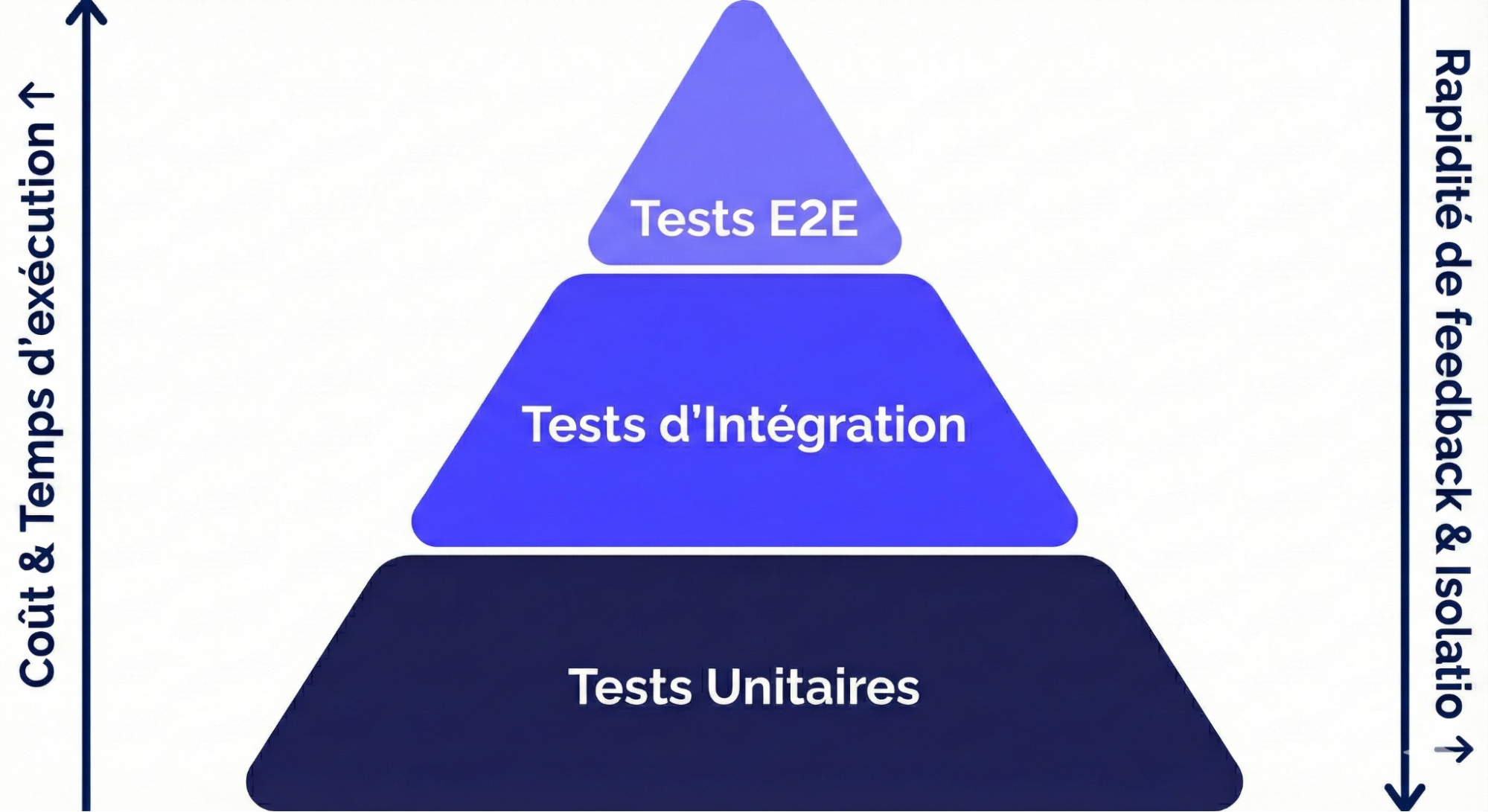
The testing pyramid is based on three distinct levels that together form a coherent strategy.
1. Unit Tests
Unit tests examine each function or method in isolation.
Their main advantage lies in their speed and their ability to pinpoint the source of a bug. When a unit test fails, you know exactly which part of the code is causing the problem.
Their maintenance costs remain low because they do not rely on any external infrastructure, which explains why they form the broadest base of the pyramid.
2. Integration Tests
At the intermediate level are integration tests, which verify that your components communicate correctly with each other and with external services such as databases or third-party APIs.
A module may function perfectly on its own but cause errors when it interacts with other parts of the system. Integration tests specifically identify these failures that unit tests miss, thereby validating the overall consistency of your architecture.
3. End-to-end (E2E) tests
An E2E test exactly replicates what a user would do (log in, navigate the interface, fill out a form, confirm a transaction).
This approach provides comprehensive validation of the system under conditions similar to those in production.
However, end-to-end testing also requires specific skills to prevent it from becoming unreliable and a source of false positives
The pyramid suggests a certain balance: many unit tests, a moderate number of integration tests, and a few E2E tests focused on critical workflows.
Choosing the Right Pyramid for Your Project Context
Technical architecture plays a decisive role in this equation.
For example, a traditional monolithic application typically follows a classic pyramid model with a broad base of unit tests, whereas a microservices architecture will require more integration tests to validate communication between services.
Interactions between distributed components then become the key area to monitor.
Business needs also guide your priorities.
For example, an online payment system poses critical software risks to financial transactions, justifying thorough end-to-end (E2E) testing of these sensitive workflows. Conversely, a rarely used secondary feature may only require basic unit testing.
Your available resources impose real constraints. A small team working under tight deadlines will need to focus its efforts on the tests that offer the best risk-to-value ratio.
Essentially, the trade-off between speed of feedback and comprehensive coverage shapes your testing strategy. Unit tests provide immediate feedback during development, while end-to-end (E2E) tests detect issues that can only be identified by taking a holistic view.
Finding the right balance between these two extremes determines the effectiveness of your quality approach.
What role do E2E tests play today?
The classic testing pyramid model isn't set in stone!
Several adaptations have emerged in response to the changing realities of modern software development.
The diamond model offers a better balance between unit and integration testing, recognizing that interactions between components often deserve as much attention as isolated units.
This approach is particularly relevant for service-oriented architectures, where communication between modules is at the heart of the business logic.
The "test trophy," popularized by Kent C. Dodds, introduces a layer of static analysis at the foundation and places integration tests at the center of the framework. This vision reflects a pragmatic reality:
- Integration testing often offers the best balance of reliability and cost for modern web applications.
- UI and visual testing play a modest but strategic role in this process.
Other alternative strategies have emerged depending on the context. The “crab” model heavily favors front-end testing for applications with a strong visual component, while the “ice cream cone” model completely reverses the traditional pyramid by focusing on manual and end-to-end (E2E) testing.
These approaches are justified in certain specific environments where the user experience takes precedence over comprehensive technical coverage.

Developing a Realistic and Sustainable Testing Strategy
Test automation is the cornerstone of a sustainable software quality strategy, one that can adapt to a project’s constant changes without blowing the budget or tying up the entire team in repetitive tasks.
The key lies in a pragmatic approach that recognizes that not all tests are created equal in terms of return on investment.
Focus on key user journeys
Focusing automation on key user flows through targeted end-to-end (E2E) tests ensures relevant coverage without falling into the trap of trying to automate everything.
These critical paths—which generate the most business value or pose the highest risks in the event of regression—deserve special attention.
The idea is not to come up with an endless number of scenarios, but to carefully select the ones that offer the most certainty.
Adopt an agile approach to corrections
Real-time monitoring of results and insights is radically transforming the way teams respond to detected issues.
Rather than waiting for a full testing campaign to conclude, developers receive immediate alerts that allow them to take swift action. This agile approach to bug fixes significantly reduces the time between detecting a bug and resolving it.
Managing the maintenance of automated tests
The maintenance of automated tests is often the neglected aspect of testing strategies, even though it determines their long-term effectiveness.
Outdated scripts generate false positives that erode the team’s confidence and eventually get ignored. Setting aside time on a regular basis to update tests, adjust selectors, and remove obsolete scenarios ensures that your test suite remains an asset rather than a burden.
Toward a Test Pyramid Tailored to Your Project
An effective testing strategy relies first and foremost on adapting the pyramid model to the realities of the project, rather than on the rigid application of a theoretical framework. Striking the right balance between unit tests, integration tests, and end-to-end (E2E) tests makes it possible to reconcile rapid feedback, functional coverage, and cost control.
Every product, every team, and every technical context involves different choices. The challenge is to maintain a clear understanding of the critical paths that need to be secured and to adjust the test distribution based on the project’s needs and maturity.
In this approach, Mr Suricate serves as an effective tool for automating key user flows and monitoring application behavior in real time. This continuous visibility makes it easier to adjust the testing strategy and helps maintain a consistent level of software quality over time.
Further Reading
- Software Testing in 2026: Trends Redefining Quality
- 2025 Comparison: Leapwork vs. Cypress vs. Smartbear – Which Automated Testing Tool Should You Choose?
- 2025 Comparison: Tricentis vs. OpenText vs. Mr Suricate Which Automated Testing Tool Should You Choose?
- Maintenance of Automated Tests
- Automated Testing for Media and Advertising
To see the solution in action, check out our end-to-end testing.
FAQ
What is the testing pyramid?
This model organizes tests into a hierarchy: many unit tests at the bottom, fewer integration tests in the middle, and a few end-to-end tests at the top. The idea is to balance coverage, speed, and maintenance costs.
What is the difference between unit, integration, and end-to-end testing?
A unit test verifies a small, isolated portion of code; an integration test verifies that multiple components work together; and an end-to-end (E2E) test validates a complete user journey.
What role do E2E tests play today?
They remain essential for validating the truly critical user journeys. Since they are more expensive to maintain, they should be targeted strategically rather than multiplied.
Should we follow the pyramid to the letter?
No. It's a guideline, not a hard-and-fast rule. The right approach depends on the project context: some applications require more E2E tests than the theory suggests.
How do you develop a realistic testing strategy?
By focusing on key user flows, managing fixes in an agile manner, and ensuring that tests remain maintainable. A no-code solution like Mr Suricate end-to-end coverage of critical user flows.
See also: The Impact of 5G and Edge Computing on Software Testing.