


At a Glance: By 2025, automated testing will have become an essential pillar of software development cycles. This guide covers: Key criteria for choosing an automated testing tool in 2025; the solution’s ease of use and accessibility; its ability to integrate with development environments; and the adaptability and maintainability of scripts.
By 2025, automated testing will have become an essential pillar of software development cycles.
As deployment cycles accelerate and web and mobile applications become increasingly complex, automated testing tools are proliferating and diversifying, offering a variety of approaches to meet the specific needs of each organization.
In this context, three major players stand out: Tricentis, OpenText, and Mr Suricate. Each offers a different approach to test automation.
This article aims to help you make an informed decision by analyzing the strengths and weaknesses of these three solutions so that you can identify the platform that best suits your needs.
Key Criteria for Choosing an Automated Testing Tool in 2025
Choosing the right automated testing tool requires a thorough analysis of several factors that directly impact team productivity and the quality of deployed applications.
1. The solution's ease of use and accessibility
No-code automation is currently a major revolution, enabling business teams and non-technical testers to create test scenarios without writing a single line of code.
This approach makes automated testing more accessible and significantly speeds up the implementation of validation campaigns.
2. The ability to integrate with development environments
Tools must integrate seamlessly intocontinuous integration and continuous deployment pipelines, communicate with existing DevOps platforms, and adapt to cloud-native architectures.
This compatibility ensures seamless automation throughout the software development lifecycle.
3. Multi-application support and the variety of functional tests
A high-performance tool must support web and mobile applications, APIs, and even legacy systems, while offering various types of testing: regression testing, end-to-end testing, performance testing, and production monitoring.
4. Script Adaptability and Maintenance
Applications are constantly evolving, and testing must keep pace with these changes without requiring a complete overhaul with every update.
5. Interoperability and Reversibility
A good tool should allow scenarios to be ported to open-source frameworks (Selenium, Playwright, etc.).
Comparison of Tricentis, OpenText, and Mr Suricate
Tricentis: For Large Enterprises and Complex Environments
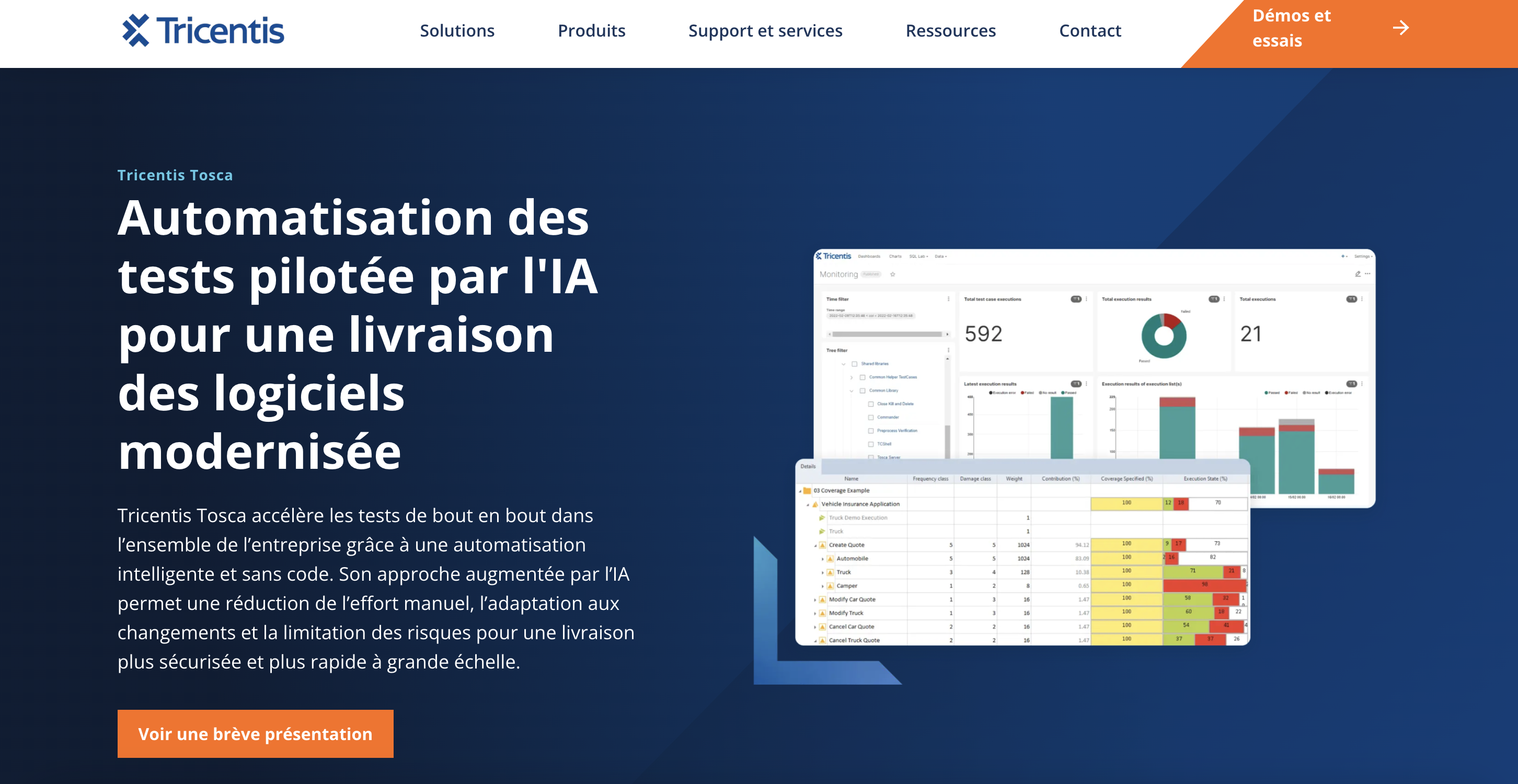
Tricentis Tosca is a powerful platform designed to address the complex challenges faced by large enterprises seeking to accelerate their delivery cycles while maintaining impeccable software quality.
The technology that sets Tricentis apart is its model-based automation engine, an approach designed to be less dependent on the technical details of the user interface.
In theory, this architecture makes it possible to create tests that are more resilient to frequent changes in applications. The tool also offers artificial intelligence capabilities to optimize the creation and maintenance of test scenarios.
The Key Benefits of Tricentis
✅ Very broad functional coverage (UI, API, performance testing, etc.): enables companies to centralize all their testing in a single tool, ensuring consistency and comprehensive visibility.
✅ Compatible with CI/CD and DevOps: The platform integrates easily with CI/CD pipelines (Jenkins, GitLab, Azure DevOps, etc.), making it easy to automate testing at every stage of the development cycle.
✅ No-code interface: allows non-technical teams (business or QA) to design test scenarios without writing code.
✅ Using artificial intelligence to optimize test maintenance: incorporates AI features that help keep test scripts up to date despite frequent changes to applications.
The Drawbacks of Tricentis
❌ High upfront cost: This remains a premium solution with a significant licensing fee. This price may be a barrier for small and medium-sized businesses or organizations with limited budgets.
❌ Steep learning curve: Mastering all of Tricentis’s features requires a significant amount of time. Extensive training is often necessary to fully leverage the platform’s potential.
❌ Requires a robust infrastructure: The tool is quite demanding in terms of technical resources. A high-performance infrastructure is required to ensure optimal response times, particularly when running a high volume of tests.
❌ Significant dependence on the vendor: this can sometimes limit the flexibility of technical teams, particularly when it comes to customizing the solution or integrating specific technologies.
*Ideal for large organizations with significant testing coverage needs and trained technical teams.
OpenText: The Robust Solution for Traditional Ecosystems
OpenText, with its long-standing tools such as UFT One and LoadRunner / Performance Engineering, has established itself as a trusted leader for companies with heterogeneous systems, legacy architectures, or complex infrastructures.
Its long history in the market gives it credibility, and its products continue to evolve as modern capabilities are integrated.
Key Benefits of OpenText
✅ Broad compatibility with web, mobile, API, and legacy technologies: enables the creation and execution of functional tests covering user interfaces, web services/APIs, and hybrid applications.
✅ Advanced AI-powered features for test maintenance: integrates AI features into its products to simplify the maintenance of test scripts.
✅ Seamless integration with DevOps tools: supports integration with tools such as Jenkins, GitLab, Azure DevOps, Bamboo, etc., to automate test execution in DevOps pipelines.
Disadvantages of OpenText
❌ Complex and unintuitive interface: There is often a steep learning curve to fully utilize its advanced features.
❌ High costs and a rigid pricing structure: OpenText licenses are often expensive, and the pricing model is complex. Adding advanced modules or scaling up can result in significant additional costs.
❌ Lack of flexibility and agility in the face of rapid changes: may require more frequent manual adjustments. The high degree of customization is an asset, but can become a hindrance when it comes to maintenance.
*Ideal for large companies with a diverse technical ecosystem and resources dedicated to automation.
Mr Suricate No-Code Automation for Everyone
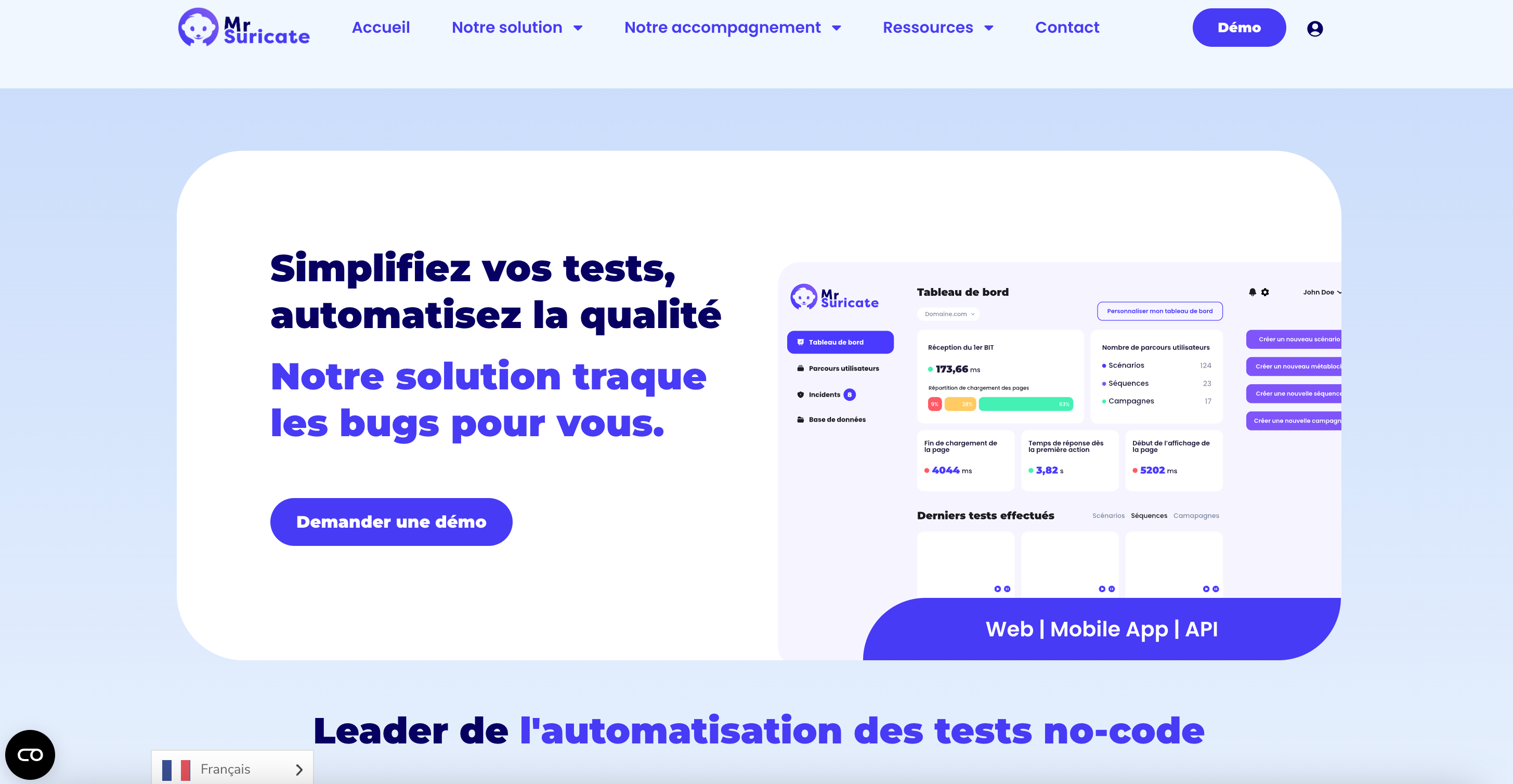
Mr Suricate offers a modern, intuitive, and 100% no-code approach to automated testing.
This French SaaS tool stands out for its ease of use and its ability to make testing accessible to all teams, both technical and business.
Designed to integrate seamlessly into DevOps environments, Mr Suricate at organizations that want to improve the quality of their web, mobile, and API applications without technical complexity or reliance on expert developers.
Key Benefits of Mr Suricate
✅ Easy-to-use no-code interface: allows you to create and maintain test scenarios without writing a single line of code. Actions are recorded using an intuitive visual engine, making automation accessible to business teams, product owners, and customer support.
✅ Real-time monitoring of user flows: Provides continuous monitoring of critical user flows in production, with real-time alerts as soon as an anomaly is detected.
✅ Seamless CI/CD integration: Integrates easily with modern continuous integration and continuous deployment (CI/CD) ecosystems, including GitLab, Jenkins, Azure DevOps, and GitHub Actions.
✅ Customer support based in France: Support is available in French, with a dedicated Customer Success Manager.
✅ Transparent, fixed pricing: offers clear, monthly, fixed pricing that includes support, updates, and guidance.
✅ Reusability plan using open-source tools (Selenium, Playwright): Test scenarios can be exported to open-source frameworks such as Selenium or Playwright if in-house development or a strategic change is planned for the future.
✅ Security and GDPR Compliance: Mr Suricate data confidentiality through secure execution environments (VPN, dedicated IP addresses, encryption) and full compliance with GDPR standards.
✅ Production monitoring: Unlike Tricentis and OpenText, Mr Suricate limited to the acceptance testing phase. The tool continuously monitors critical user flows in production and issues real-time alerts as soon as a bug impacts the customer experience.
Mr Suricate Suricate's Drawbacks
❌ Less suitable for highly advanced technical testing (e.g., thick-client applications): primarily designed for testing web or mobile user interfaces. For highly technical scenarios, such as thick-client applications, complex network testing, or embedded systems, it may be necessary to supplement this solution with other, more specialized tools.
❌ Customization limitations: Its simplified approach may limit the ability to customize highly advanced test scenarios for more experienced testers looking for additional features.
*Ideal for small and medium-sized businesses, large enterprises, and agile teams looking for a solution that is simple, quick to deploy, and scalable.
Summary Comparison Table
|
Criterion |
Tricentis |
OpenText |
Mr Suricate |
|
Orientation |
Large Companies |
Legacy ecosystems |
Agility & Simplicity |
|
No-code |
Yes (partial) |
Partial |
✅ 100 % |
|
CI/CD |
✅ |
✅ |
✅ |
|
Production Monitoring |
❌ |
⚠️ |
✅ |
|
GDPR / Sovereignty |
❌ |
⚠️ |
✅ 🇫🇷 |
|
Support |
Global |
Global |
Global |
|
Pricing |
High |
High |
Transparent |
|
Time to Value |
Slow |
Medium |
Rapid |
Our recommendation
If your priorities are agility, ease of implementation, and a true DevOps approach, Mr Suricate an excellent choice.
For more complex or traditional needs, Tricentis or OpenText will remain the go-to solutions, provided you have the resources to make the most of them.
Try Mr Suricate A multi-browser, multi-device automated testing solution
Mr Suricate 's greatest value proposition Mr Suricate that it combines its SaaS solution with high-quality service and enables non-IT professionals to become testers in less than a month.
With Mr Suricate, you don't need to know how to code or spend a fortune to ensure your users have a smooth, bug-free browsing experience—no matter how they access your site!
Further Reading
- 2025 Comparison: Leapwork vs. Cypress vs. Smartbear – Which Automated Testing Tool Should You Choose?
- How to Choose the Best Automated Functional Testing Tool in 2023?
- Tag Management: Steps for Setting Up an Analytics Testing Tool
- The no-code script editor
- Integration with your test management tools
- The Mr Suricate Automated Testing Solution
- Tricentis Tosca vs. Mr Suricate: A Comparison
- OpenText UFT vs. Mr Suricate: A Comparison
- Selenium, Cypress, or Mr Suricate: A Comparison
FAQ
What criteria should you use to choose an automated testing tool in 2025?
Five criteria are important: ease of use, the ability to integrate with development environments, support for multiple applications, the adaptability and maintainability of scripts, and interoperability and reversibility to avoid vendor lock-in.
Tricentis, OpenText, or Mr Suricate Which One Should You Choose?
Tricentis for a large enterprise ready to invest in a full-featured platform; OpenText for a traditional ecosystem already in place; Mr Suricate you want accessible no-code solutions, integrated testing and monitoring, and controlled costs—whether for a business team or a large enterprise.
What is the difference between Tricentis and Mr Suricate
Tricentis is a very comprehensive enterprise platform, but it requires significant expertise and a substantial budget. Mr Suricate no-code simplicity and rapid deployment, while still meeting the needs of large enterprises: multi-application support, monitoring, reversibility, and dedicated support.
Do these tools support reversibility?
This is a key factor in avoiding dependency. Mr Suricate specifically Mr Suricate a fallback plan involving open-source frameworks such as Selenium or Playwright, which limits the risk of vendor lock-in.
How much does each solution cost?
Tricentis and OpenText primarily operate on a quote-based model, with budgets geared toward large enterprises. Mr Suricate a fixed monthly rate, which makes it easier to manage costs over the long term.
Learn more: our comparison of automated testing tools.