


In a nutshell: First introduced in the 1980s, the V-model is the so-called “traditional” project management method. This guide covers: V-model or Agility?, The Agile Manifesto, The Twelve Principles of Agile Methodology, What Does This Mean in Practice?.
More adaptable and flexible, the agile methodology is increasingly replacing traditional V-model project management. But what exactly does agility entail? Let’s take a quick look!
V-Model or Agile?
First introduced in the 1980s, the V-model is the so-called “traditional” project management method. It involves breaking a project down into a series of stages: requirements analysis, drafting of functional specifications, development, unit testing, integration testing, validation testing, and acceptance testing. Each stage is associated with a validation phase. Its main advantages lie in its ease of implementation and its “tunnel effect,” which prevents backtracking. But this tunnel effect is also what critics point to as a drawback, since it leaves no room for changes during development and thus limits adaptability and responsiveness. And the problem today is that it is difficult to anticipate every possible situation and therefore to define requirements accordingly.
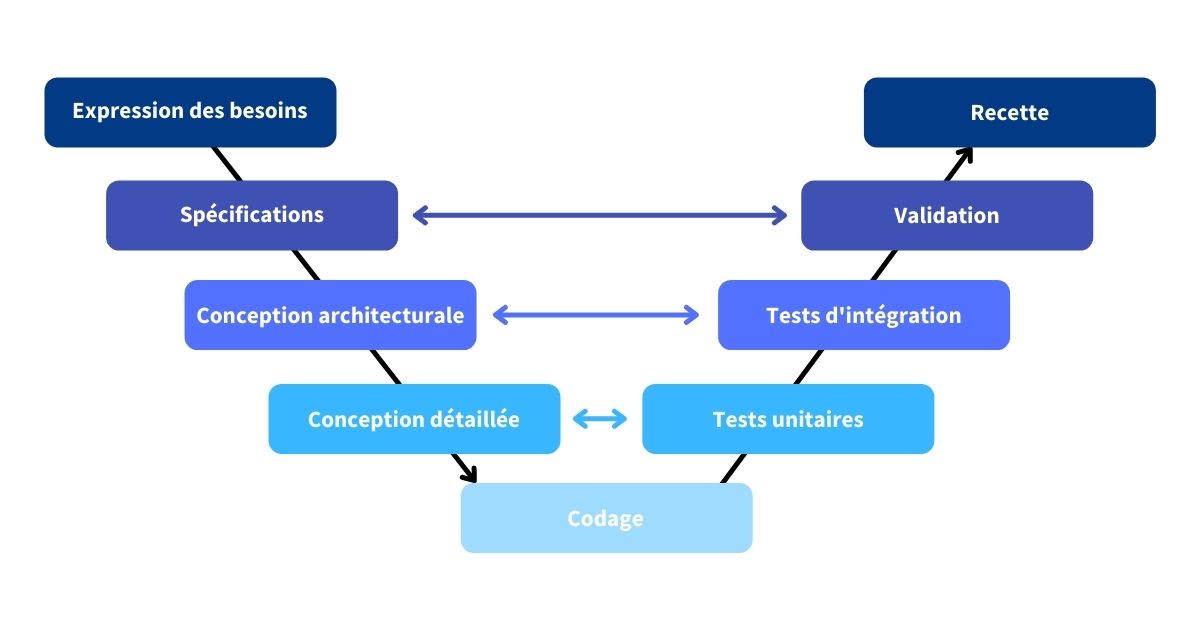 V-Shaped Cycle
It was this lack of flexibility that allowed the Agile methodology to develop and stand out. In particular, Agile emphasizes communication and collaboration among self-organized, multidisciplinary teams while placing the customer at the heart of the project. It emerged in response to the high project failure rate observed in the 1990s. In 2001, 17 software development experts gathered in the United States and pooled their respective methods, thereby creating the “Agile Manifesto”.
The Agile Manifesto
Considered the canonical definition of agile development, the Agile Manifesto consists of four values and twelve guiding principles.
“We discover better approaches to software development by practicing it and helping others practice it. This work has led us to place importance on:
on individuals and their interactions rather than on processes and tools;
working software rather than comprehensive documentation;
collaboration with clients rather than contract negotiations;
adapting to change rather than following a plan.
"This means that, although there is value in the elements at the end, we prefer the elements that appear at the beginning of the sentence. "
The Twelve Principles of Agile Methodology
1. Our top priority is to satisfy our customers by quickly and consistently delivering high-value features.
2. Embrace changes in requirements, even late in the project. Agile processes leverage change to give the customer a competitive advantage.
3. Deliver working software frequently, in cycles ranging from a few weeks to a few months, with a preference for shorter cycles.
4. Users or their representatives and developers must work together daily throughout the project.
5. Carry out projects with motivated people. Provide them with the environment and support they need, and trust them to achieve the set goals.
6. The simplest and most effective way to convey information to and within the development team is through face-to-face dialogue.
7. Working software is the primary measure of a project’s progress.
8. Agile processes encourage a sustainable development pace. Together, sponsors, developers, and users should be able to maintain a steady pace indefinitely.
9. Continuous attention to technical excellence and good design.
10. Simplicity —that is, the art of minimizing unnecessary work —is essential.
11. The best architectures, specifications, and designs emerge from self-organizing teams.
12. At regular intervals, the team reflects on ways to become more effective. It then adapts and modifies its operations accordingly.

In practical terms?
Rather than setting long-term goals, the agile methodology is based on short-term goals. Everything is done as we go. And since customer satisfaction is the top priority, each step is approved by the customer. This makes it easier and faster to adapt in the event of changes or unforeseen circumstances and to meet the customer’s expectations. There is a genuine relationship and collaboration between the team and the client, which allows everyone to move forward efficiently and stay on the same page.
The agile approach is a highly adaptable and flexible project management method. Almost everything can be adjusted. Quality may be a bit less adaptable, but everything related to scope, budget, and timeline can easily be modified, depending on the method used (Scrum, Kanban). This allows teams to be more responsive when problems arise, boosts team performance, and provides greater control over the final product—thereby improving its quality. And a high-quality final product means satisfied users who are more likely to spend money!
Keep in mind that agility is not a magic solution that can be applied to all organizations and projects. For it to work, certain conditions must be met: an organizational culture that fosters collaboration and is not based on overly rigid structures, a multidisciplinary team, and a client who is available and willing to get involved in the project.

However, there are some limitations to agility. For example, while the absence of well-defined processes promotes team independence, it can also distract teams. It is therefore important to establish mechanisms to coordinate all stakeholders and to measure progress—particularly by defining key performance indicators—to ensure that teams do not lose their way. Furthermore, due to the unpredictability of the agile methodology, it is difficult to determine the project’s cost, required resources, and timeline —and this must be taken into account before getting started.
And while the Agile method may seem like the “best” solution, it is not actually at odds with the V-model, which remains a very suitable approach depending on the project. It all comes down to context, so it’s important to examine both methods to determine which one is best suited to your project.
As for the question, “How can we apply agile methodology to testing?”—that will be the subject of a future article! We have to keep you coming back, after all 😉

FAQ
V-Model or Agile?
First introduced in the 1980s, the V-model is the so-called “traditional” project management method. It is based on breaking a project down into a series of stages: requirements analysis, drafting of functional specifications, development, unit testing, integration testing, validation testing, and acceptance testing. Each stage is associated with a validation phase.
In practical terms?
Rather than setting long-term goals, the agile methodology is based on short-term goals. Everything is done as we go. And since customer satisfaction is the top priority, each step is approved by the customer.
Further Reading
Learn More: The Glossary of Automated Testing.