


The Essentials in 30 Seconds
- A QA process outlines how a team ensures the quality of software, from defining objectives to automating tests.
- According to the CISQ (Carnegie Mellon), poor software quality costs U.S. companies 2,410 billion dollars a year.
- The cost of fixing a bug increases 100-fold between the design phase and production (sources: NIST, IBM SSI).
- Implementing QA early ("shift-left") reduces costs, speeds up deliveries, and safeguards the user experience.
- Mr Suricate supports QA teams with a no-code platform and turnkey outsourcing services.
Software quality protects your revenue. No one notices it when it works. Everyone notices it when it breaks.
A well-structured QA (quality assurance) process helps detect errors before they reach your users. The CISQ, an organization co-led by Carnegie Mellon’s Software Engineering Institute, estimates that poor software quality costs U . S. companies alone $2,410 billion annually. This figure includes operational failures, abandoned projects, and accumulated technical debt.
At Mr Suricate, we help teams every day to set up and automate their QA processes. This guide summarizes the 12 steps we recommend for building a robust QA process, even when starting from scratch.
What is a QA Process?
The QA process encompasses all the practices that ensure software meets defined quality expectations. Planning, monitoring, and test execution: every stage of the development cycle is involved.
This is not a final check before going into production. It is an ongoing process. In other words, the goal is to prevent defects rather than correct them after the fact, when the cost and impact are magnified.
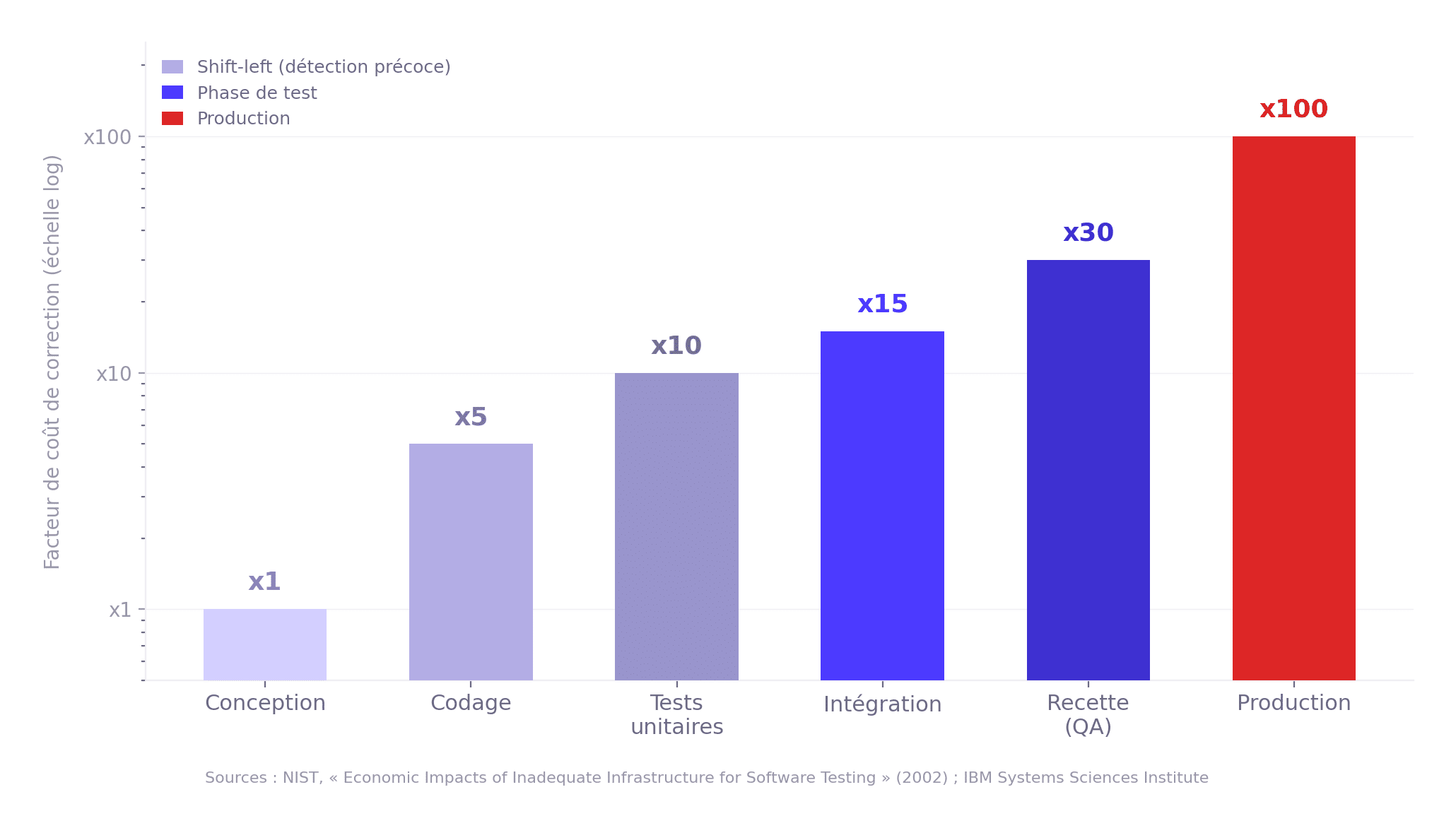
According to benchmarks compiled by the CISQ (2022 report) and the IBM Systems Sciences Institute, the cost of fixing a bug skyrockets with each stage it passes through undetected. The observed cost multipliers are: x5 during coding, x10 during unit testing, x15 during integration, x30 during acceptance testing, and up to x100 in production compared to the design phase.
Why the QA Process Protects Your Business
Three main reasons.
Reduce correction costs. A defect detected during production costs up to 100 times more to correct than the same defect identified during the design phase (see the cost curve below). This multiplier has been documented by research from NIST and the IBM Systems Sciences Institute, and is regularly confirmed by real-world feedback from engineering teams.
Protecting developer productivity. According to research by Gloria Mark (University of California, Irvine, 2008, cited in her book *Attention Span*, 2023), every interruption to investigate a bug in production costs an average of 23 minutes of lost concentration. At a rate of 10 bugs per week, this amounts to nearly 4 hours lost to context switching alone, not counting the time spent investigating the bugs.
Ensure compliance. Rigorous QA governance facilitates compliance with regulatory requirements, particularly regardingaccessibility (WCAG) and GDPR compliance.
The 12 Steps to Implementing a QA Process
1. Define quality objectives
QA testers must understand the software's functional and non-functional requirements from the very beginning of the development cycle. Improving overall reliability, reducing the number of bugs in production, and optimizing performance: these objectives guide everything else.
Once these objectives have been established, the scope and types of tests to be conducted (functional, performance, security, etc.) become clear.
2. Assemble the QA Team
The team's composition depends on your resources and constraints. Full-time QA engineers, specialized contractors, or junior staff developing their skills: each configuration has its advantages.
QA outsourcing is an option that is often underestimated. It allows you to keep costs under control while benefiting from a structured testing framework developed by experts. At Mr Suricate, every client is assigned a dedicated account manager who provides personalized support for implementing and optimizing the QA process.
3. Define a Testing Strategy
The testing strategy identifies the types of tests to be conducted (functional, performance, security, accessibility) and prioritizes them based on risk. Areas with a high user impact or a high probability of failure are addressed first.
The 16th annual Capgemini World Quality Report (2024–2025) reveals that 68% of organizations are already using generative AI to advance their quality engineering. This is no longer an emerging trend—it is an established practice.
The role of AI at this stage: AI helps identify high-risk areas in an application by analyzing defect history and recent code changes. It also allows for prioritizing tests based on actual business impact, rather than testing “a little bit of everything” across the board.
4. Developing a Testing Methodology
The methodology is tailored to the size of the team, the complexity of the project, and the deadlines. In practice, teams often combine several approaches: Scrum for organizing sprints and DevOps for continuous integration, for example.
Waterfall (V-Model): linear progression, with each phase completed before the next. Suitable for stable projects with requirements that do not change. Little flexibility in the event of unforeseen circumstances.
Scrum: Development broken down into short sprints with daily stand-ups. Works well for self-managing teams that iterate quickly.
Kanban: visual management of work in progress using a task board. Particularly useful for streamlining workflows between QA and development.
DevOps: Development and operations move forward together. Continuous testing is integrated into the CI/CD pipeline to enable fast and reliable deliveries.
XP (Extreme Programming): Emphasis on automated testing, iterative development, and close collaboration between developers and testers.
5. Create a Test Plan
The test plan is the reference document that describes what is being tested, how, with what resources, and according to what success criteria. It ensures that all stakeholders are aligned on the objectives, deadlines, and required efforts.
A comprehensive test plan includes:
- Types of tests planned: functional, usability, security, and performance tests
- Test Coverage Goals
- Success criteria (the software passes or fails)
- The allocation of human resources, tools, and environments
- Expected deliverables: test cases, defect reports, summary reports
The role of AI at this stage: Generative AI can speed up the creation of test cases based on functional specifications and suggest test scenarios that the team might not have considered (edge cases, rare parameter combinations).
6. Organize the acceptance testing phase
Before any system goes live, rigorous validation is required. This process involves the QA teams, developers, product owners, and business managers.
Testing focuses primarily on critical features and the most common customer journeys. QA specialists run automated and manual test scenarios, developers fix any identified issues, and business users confirm that the use cases align with real-world scenarios.
A final validation in a pre-production environment simulates real-world conditions prior to deployment. It serves as the last line of defense.
7. Conduct exploratory tests
Exploratory testing complements formalized testing. There is no predefined script: the tester relies on their intuition, experience, and knowledge of the product to explore paths that standard test scenarios do not cover.
This approach identifies unexpected behaviors, UX inconsistencies, or flaws in complex user journeys. The involvement of product owners and domain experts is invaluable here, as they understand real-world usage better than anyone else.
Exploratory testing is most often conducted just before deployment or after major changes.

8. Implement test automation
This is the step that takes your QA process to the next level. Choose an automated testing tool that’s compatible with your CI/CD pipeline to run tests automatically with every build.
Start with a limited but strategic scope. Critical test suites and non-regression tests (NRTs) are the first candidates for automation: they are repetitive, essential, and take a considerable amount of time to run manually.
No-code platforms such as Mr Suricate make it possible to automate processes without writing code, which makes automation accessible to QA teams without development skills.
The role of AI at this stage: modern testing tools incorporate self-healing mechanisms that automatically update element selectors when the interface changes. This drastically reduces the maintenance time of automated tests , one of the primary obstacles to the adoption of automation.
9. Implement "shift-left" (and "shift-right")
"Shift-left" involves integrating testing activities as early as possible in the development cycle. Instead of testing after the code is written, quality is built in from the design phase.
In 2026, the top-performing teams will combine "shift-left" and "shift-right":
- Shift-left: testable acceptance criteria starting with the drafting of user stories, static analysis on every commit, and automated tests in the CI pipeline
- Shift-right: production monitoring, feature flags to quickly disable risky behavior, production monitoring to catch what tests missed
This end-to-end process reduces correction costs and speeds up deliveries.
10. Track key metrics
Tracking metrics is essential for evaluating the effectiveness of the QA process and identifying areas for improvement.
The metrics that matter: test pass rate, number of defects detected by test type, automated test coverage rate, and average time to resolve defects. QA teams, developers, and Product Owners should review these metrics regularly to adjust testing strategies.
The role of AI at this stage: AI can analyze trends in test results to detect recurring regression patterns, identify the most fragile modules, and recommend where to focus testing efforts in each sprint.
11. Keep QA documentation up to date
QA documentation must reflect the latest changes to the application and provide a useful history of testing activities.
In practice: Schedule debriefing sessions after key project milestones. Make sure that every document is useful, up-to-date, and accessible to the entire team.
12. Drive continuous improvement
A QA process is never set in stone. Technologies evolve, development methods change, and user expectations grow.
Regular reviews make it possible to analyze what is working, what is causing issues, and what can be automated or simplified. The involvement of the entire project team (testers, developers, project managers) in the quality assurance process is the most critical factor for a QA process that continues to improve over time.
Best Practices and Common Mistakes
What works:
- Involve QA from the design phase onward (shift-left)
- Foster a cross-functional culture of quality that isn't limited to the QA team
- Automate repetitive tests while continuing to perform exploratory testing on critical cases
- Test in an environment that is as close as possible to the production environment
Things that waste time (and money):
- Relying solely on manual testing when the volume of regression testing skyrockets
- Ignoring actual usage conditions (device types, operating systems, network latency)
- Postponing security tests “until later” (vulnerabilities discovered after a data breach cost an average of $4.44 million, according to the IBM Cost of a Data Breach 2025 report)
Summary Checklist: The 12 Steps of Your QA Process
| # | Step | Key Question | The Role of AI |
|---|---|---|---|
| 1 | Define Quality Objectives | What results do you expect from QA? | – |
| 2 | Build the QA team | Internal, external, or hybrid? | – |
| 3 | Define the testing strategy | What types of tests, and in what order of priority? | Risk Analysis Based on Historical Failure Data |
| 4 | Developing a Methodology | Scrum, DevOps, Kanban, or a combination? | – |
| 5 | Create the test plan | Who tests what, when, and based on what criteria? | Generating Test Cases from Specifications |
| 6 | Organize the recipe | Have the critical paths been validated? | – |
| 7 | Exploratory Tests | What don't the scripts cover? | – |
| 8 | Integrating Automation | Which tests should be automated first? | Self-healing, automatic maintenance of selectors |
| 9 | Shift-left and shift-right | Does QA begin right from the design phase? | Automated CI → Monitoring → CI Loop |
| 10 | Track metrics | Is the process improving with each sprint? | Regression Pattern Detection |
| 11 | Maintain the documentation | Are the test cases up to date? | Automated Documentation of Test Scenarios |
| 12 | Continuous Improvement | What areas should we focus on to improve performance in the next quarter? | – |
Organize your QA process with Mr Suricate
Mr Suricate is the French no-code automated testing platform that covers the entire QA scope: functional, non-regression, end-to-end, accessibility, performance, API, and production monitoring testing.
Don't have the resources to handle QA in-house? Our QA outsourcing services give you access to a dedicated team, from scenario creation to maintenance.
FAQ
It is the structured set of practices that ensure the quality of software throughout its life cycle. It covers the definition of quality objectives, team formation, testing strategy, test plan, acceptance testing, exploratory testing, and automation. It is a preventive approach, not a last-minute check.
By following 12 key steps: defining objectives, assembling the team, establishing a strategy and selecting a testing methodology, drafting a test plan, organizing acceptance and exploratory testing, and then incorporating automation and metric tracking. The “shift-left” approach—which involves testing as early as possible—strengthens the entire process.
Because it reduces the cost of fixing bugs (a factor of 100 between design and production, according to NIST and IBM SSI), protects developer productivity, and ensures a secure customer experience. The CISQ estimates that poor software quality costs $2,410 billion annually in the United States. Quality isn’t a cost—it’s an assurance.
No. Automation is cost-effective for high-value, repetitive tests (regression, critical paths, load testing). Exploratory testing and certain manual test cases remain essential for detecting anomalies that scripts do not cover. The balance between the two depends on the volume of tests, the delivery frequency, and the available resources.
AI plays a role at several levels: prioritizing tests through risk analysis, generating test cases from specifications, self-healing automated tests when the interface changes, and detecting regression patterns in results. According to the Capgemini World Quality Report 2024-2025, 68% of organizations are already using generative AI in their quality engineering. AI does not replace QA expertise; rather, it speeds up repetitive tasks and frees up time for exploratory testing and strategic thinking.
The choice depends on your technical skills and your needs. No-code solutions like Mr Suricate allow you to automate processes without writing code, making them accessible to non-developers. Open-source frameworks (Selenium, Cypress, Playwright) offer more flexibility but require development skills. A comparison of automated testing tools can help you make a more informed decision.