









End-to-end (E2E) testing: Validate your end-to-end user flows
A feature may work on its own… but fail when integrated into a complete user flow. End-to-end (E2E) testing allows you to verify that the entire user flow works correctly, from start to finish, under real-world conditions. It ensures the overall consistency of your applications and processes.
What is an end-to-end (E2E) test?
An end-to-end test involves simulating a complete scenario by replicating the actual sequence of actions performed by a user or a business process.
It allows you to test:
- a series of features
- interactions between systems
- data flows
- the complete courses
The goal: to make sure everything works together seamlessly.
Why are end-to-end tests essential?
A feature may work on its own… but fail as part of an end-to-end workflow. End-to-end testing helps identify these issues that are invisible when tested in isolation.
In today's systems, applications are interconnected:
- front-end + back-end
- APIs
- third-party tools
- business systems
Without E2E tests:
- errors occur between systems
- some user flows break
- business workflows are interrupted
- bugs make it into production
The Limitations of Manual End-to-End Testing
End-to-end tests are among the most critical… but also the most complex to perform manually.
The scenarios involve several steps and systems.
Playing through an entire course takes a lot of time.
They are not executed with every release.
Critical anomalies may go unnoticed.
Why automate functional testing
Automation makes end-to-end testing reliable and scalable. It enables:
- run the entire routes automatically
- test with each update
- detect anomalies earlier
- ensure the reliability of interactions between systems
End-to-end testing is becoming a comprehensive security tool.
Tired of time-consuming manual testing?
Switch to no-code automation—it will transform the way you think about testing!
The Benefits of Automated Functional Testing
Overall consistency of systems
All the elements work together seamlessly.
Detection of critical errors
Issues affecting the entire process are quickly identified.
Operational Security
Business processes remain reliable, even after changes.
Time saving
Complex scenarios are executed automatically.
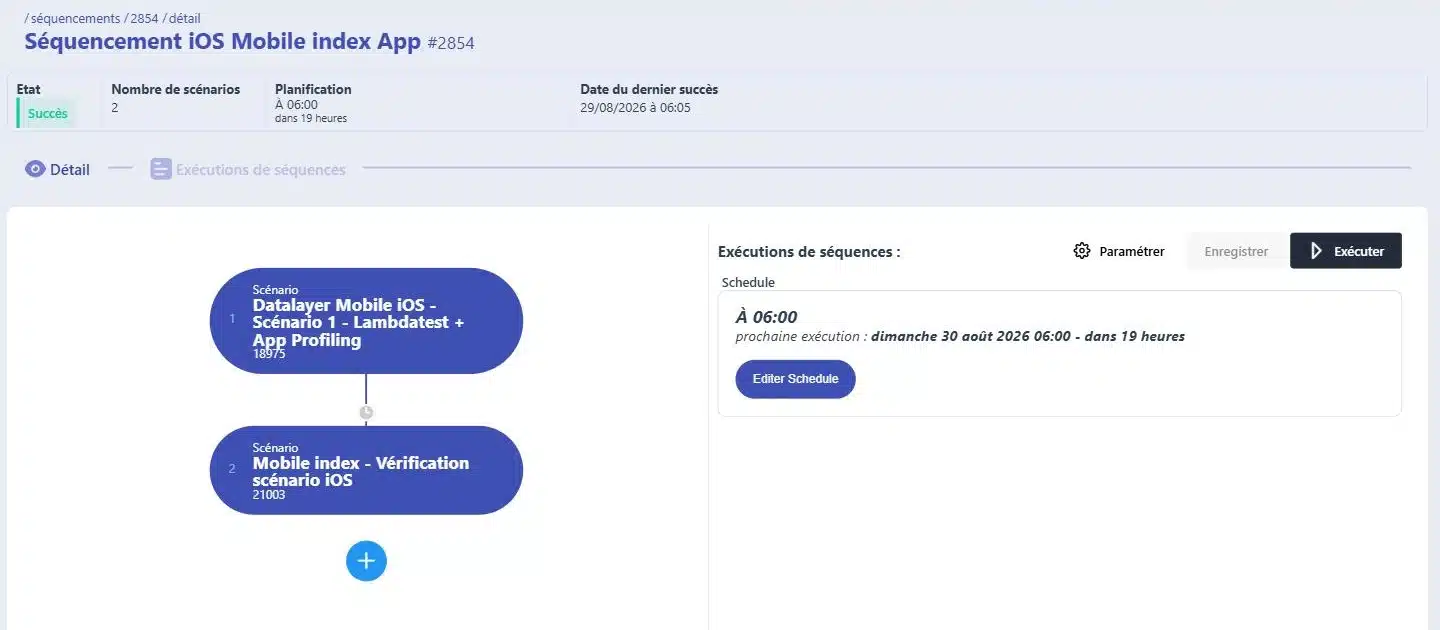
How Mr Suricate Simplifies End-to-EndTesting
Mr Suricate you to automate entire workflows without any technical complexity.
Development of comprehensive scenarios
- simulation of actual routes
- no-code development
- consideration of sequences
Automated execution
- tests run with every release
- continuous operation
- prioritization of critical paths
Simplified maintenance
- Adapting to change
- AI-assisted proofreading
- Stability of scenarios
The result: robust end-to-end tests that remain reliable over time and can be deployed at scale.
Functional Testing FAQ
An end-to-end test verifies that a complete workflow functions correctly from start to finish, incorporating all steps and systems.
They make it possible to detect errors that occur only in complex scenarios involving multiple systems.
A functional test verifies a single feature. An end-to-end test verifies an entire workflow.
Because they are complex, time-consuming, and critical to overall quality.
These tests are complementary:
Functional tests validate a feature.
Non-regression tests (NRTs) ensure the reliability of updates.
End-to-end (E2E) tests validate the entire user flow.
Together, they cover the entire test scope.
Learn more about functional testing
Learn more about non-regression testing
There's more to life than just functional testing
Mr Suricate all your testing needs, from user experience to internal systems

