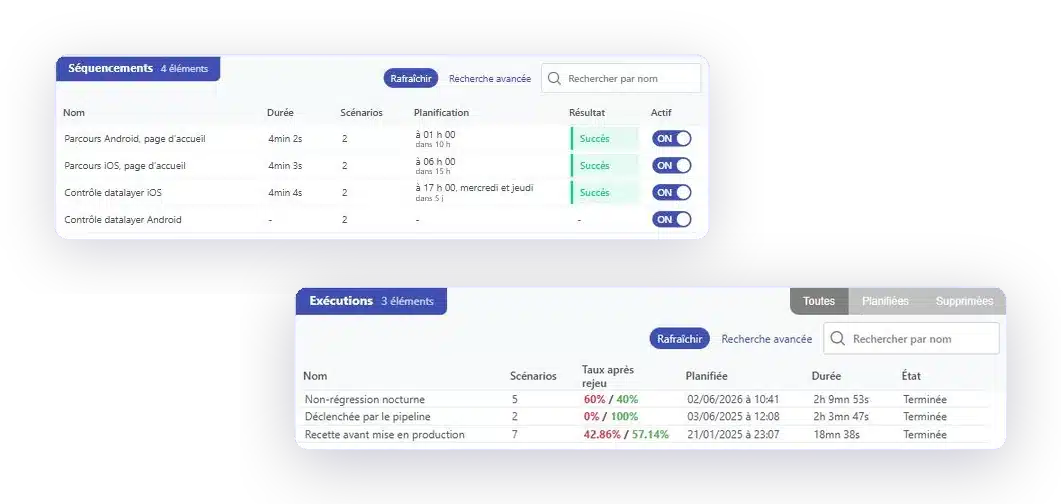
With Mr Suricate, your automated tests run directly from your CI/CD pipeline. They can be triggered with every build from Jenkins, GitLab, or Azure, or scheduled to run as frequently as every 5 minutes. Your critical workflows remain under constant monitoring, and alerts are sent before your users even call.
Pipeline Triggering· Recursion starting at 5 minutes· Without a single line of code

Your CI/CD pipeline protects the moment of delivery. It says nothing about the hours that follow, when a certificate expires, a third-party API slows down, or a content change breaks an order funnel. The outage isn’t caused by any specific build, and you find out about it from customer service. Continuous testing means running the same scenario at regular intervals—up to every 5 minutes—in the production environment.
Across our entire customer base, we process 3 million scenario executions per month.
Your tests run with every build—from Jenkins, GitLab, Azure DevOps, or your orchestrator—via API call or webhook.
Each scenario has its own recurrence interval, ranging from every 5 minutes to once a month. Critical paths are replayed without anyone even thinking about it.
Recipe, pre-production, production. The same scenarios, with the specific data sets for each environment.
The status is returned in the build, and a failure triggers an incident that is sent to your channels: SMS, email, Slack, Teams, or PagerDuty. No one has to open yet another tool.
Recurrence is configured on a per-scenario basis, directly within the application. A payment pipeline can run every 5 minutes, while a billing export may only run once a month.
Three steps, regardless of the trigger, and none of them require you to take out your tools.
Your scripts run on your production environments
The tool integrates with our other tools to run the necessary tests as needed, and continuously runs non-regression tests to ensure that everything is working properly.
Romain, Product Manager at an online media company. 5-star review posted on GetApp.
Market insight: The top-performing teams deploy 208 times more often than the lowest-performing teams, with a failure rate that is 7 times lower. Source: Accelerate State of DevOps Report 2019, DORA, and Google Cloud.
GO FURTHER
Every component of the platform, from scenario creation to verification of its execution.
Is there a term you don't understand? The automated testing glossary defines it.
YOUR QUESTIONS
Execution frequencies, alerts, environments, and production rollouts being blocked: answers to the most frequently asked questions.
Via an API call from your orchestrator, or via a webhook. Jenkins, GitLab, and Azure are the most common options among our customers. The call triggers the scenarios tagged for the target environment in Mr Suricate , and scheduling remains available for tasks that do not depend on a build.
It's up to you. The status is returned in the build via the API Mr Suricate, and you choose whether it simply notifies the team or halts the pipeline.
No. The scenarios run on your existing environments—acceptance testing, pre-production, or production—using the specific datasets for each one.
It is measured in tens of minutes rather than days. The time savings observed among our customers are up to fifteen times faster than manual methods.
Some selector failures are automatically resolved through self-healing. The rest are reported as incidents, along with the failed step and the capture, and the correction of a block is propagated to all scenarios that use it.
Recurrence is set on a per-scenario basis. The shortest interval is 5 minutes, followed by 10, 15, and 30 minutes; every hour; 2 or 4 times a day; daily; weekly; and monthly. A custom calendar allows you to select specific days and time slots. Campaigns and sequences, on the other hand, can be scheduled by day, week, or month, with one or more runs per day.
No, and it's neither APM nor RUM: your code isn't instrumented. Traditional monitoring simply confirms that the server responds and the page loads. A scenario replays the entire user journey in a real browser—logging in, filling out forms, submitting them, and verifying that each step is successful. The two approaches are complementary. For the business perspective on this monitoring, see our page on production monitoring.
A scenario is a browser session, not a load test: at 5 minutes per session, that amounts to 288 runs per day for this scenario. The real question is how many paths are set to the shortest interval, and this trade-off must be decided at the outset: critical paths at the finest interval, and the rest at wider intervals.
A failure triggers an incident in Mr Suricate and then triggers the configured notification: SMS, email, Slack, Microsoft Teams, Discord, Google Chat, or PagerDuty. The incident groups together all failed scenarios during the period and serves as an entry point for replaying the execution to see where it stops.
A 30-minute demo on your own channel. You'll see a build trigger a campaign, and a scheduled scenario run on its own and then open an incident.