


In brief: Automated testing has evolved considerably over the years, and the demand for more accessible and efficient solutions has never been stronger. This guide covers: Low-code: Easy access to the power of automation, No-code automated testing: The Holy Grail of automation, Benefits of no-code automated testing in the cloud, Challenges and Limitations.
Test automation has significantly evolved over the years, and the demand for more accessible and efficient solutions has never been stronger.
This is where low-code or no-code automated testing comes into play, offering an innovative approach that empowers individuals, regardless of their technical expertise, to conduct high-quality automated tests.
A brief overview of the concept of testing in IT. Testing is a systematic evaluation of an application, system, or component to verify that it fulfills its defined functions and criteria. Its purpose is to identify defects or deficiencies by comparing actual results with expected outcomes. An automated test, on the other hand, is a variation of this process where the execution of tests is performed by software. Instead of a human tester manually clicking on different parts of the application and observing the results, an automated test script executes these actions rapidly and compares the results against expected values, enabling faster and more accurate evaluation. Often, this test automation is created by a developer or an automation engineer.
That’s why more and more companies are turning to “no-code” or “low-code” automation solutions. In this article, we’ll explore the benefits of low-code and no-code in the context of automated acceptance testing and production monitoring, and offer some initial tips on how to implement them.
Low-code: Easy Access to the Power of Automation
 Low-code refers to a software development methodology that enables the creation of applications and automated processes using an intuitive visual interface rather than manual coding. This approach unlocks numerous benefits, particularly in the realm of automated testing.
- Increased Accessibility: One of the primary advantages of low-code automated testing is that it makes the creation of automated tests accessible to a much broader audience. Testers do not require programming expertise, which means non-technical teams can actively participate in the testing process.
- Accelerated Development: Thanks to user-friendly visual interfaces, testers can create automated test cases in record time. According to a recent survey, companies that adopted low-code solutions observed an impressive 75% reduction in their development time.
- Reduced Technical Dependency: Traditionally, the creation of automated tests was primarily handled by developers and automation experts. With low-code, testers can become autonomous, thereby reducing reliance on technical resources.
- Rapid Adaptability: No-code/low-code automated testing platforms enable rapid adaptation to changes, whether it involves a user interface update, the addition of new functionalities, or API modifications.
- Scenario Flexibility: With low-code solutions, you have the ability to create highly customized test scenarios that can be easily adjusted to accommodate your company's specific needs.
- Feature Versatility: Many no-code automated testing tools offer comprehensive feature suites, ranging from front-end functional tests to load tests, as well as API monitoring and SEO tests. This enables a holistic approach to testing.
No-code Automated Testing: The Holy Grail of Automation
 Automated Testing No-code solutions go even further by virtually eliminating the need for coding. This means that individuals without any technical experience can seamlessly perform automated tests. Here's how this benefits your business:
- Training Cost Savings: Training testers as engineers is no longer necessary, which reduces costs associated with specialized technical skills. On average, our clients see a 30 to 60% reduction in training costs. At Mr Suricate, 90% of users become proficient with the tool within 3 weeks.
- Faster Execution: No-code automated tests can be created and executed faster than ever, leading to an average 30% acceleration in development cycles. This enables earlier problem detection, thereby reducing delivery delays.
- Increased Test Coverage: Low-code tools make test management simpler and more intuitive, which accelerates decision-making and facilitates the addition of new scenarios. This efficiency results in improved test coverage, estimated at 20% to 30%.
- Reduction of Human Errors: By automating the testing process without coding, potential human errors are minimized, ensuring more reliable results.
Benefits of No-code Automated Testing in the Cloud
 While no-code testing is traditionally performed with on-premise technologies, where users download existing no-code testing solutions as Software Development Kits (SDKs), cloud-based no-code testing platforms enable users and businesses to meet several robust requirements concerning scalability, speed, collaboration, quality, and security. This frees up time to focus on product innovation.
- Infinite Scalability: Cloud services benefit from unlimited scalability with thousands of on-demand virtual desktop machines. No setup fees are required, which helps meet strict project deadlines and test coverage goals.
- Enhanced Execution Speed: Cloud computing solutions leverage powerful machines, robust infrastructure, and a network that can significantly improve automated test execution time and performance. Cloud-based solutions also provide easy access to platforms across various geographies via globally distributed data centers.
- Collaborative Platform: The advantage of using a cloud-based platform is that it facilitates collaboration. You can share your test scenarios, scripts, and results with your team members wherever they are located, thereby enhancing efficiency and effectiveness.
- Quality Throughout the SDLC: Continuous testing in the cloud is not solely about test creation, but also encompasses the entire process of mitigating software risks by conducting relevant tests and providing rapid feedback to developers upon any code change.
- Enhanced Security: Cloud solutions provide a significantly more advanced level of test data security compared to on-premise installations.
- Adjustable KPIs: Modern solutions, particularly cloud-based ones, enable you to tailor Key Performance Indicators (KPIs) to your project's specific context. This allows for tracking specific metrics most relevant to your objectives.
- Advanced Production Performance Monitoring: Cloud-based automated testing solutions also provide advanced production performance monitoring tools, including availability, load time, and Web Core Vitals. These tools enable real-time tracking of your application's performance.
- Accelerated Time to Market: Through real-time bug detection, no-code/low-code automated testing can significantly accelerate your product's time to market. This is crucial in today's competitive landscape.
Challenges and Limitations
While acknowledging the undeniable benefits of low-code/no-code, it is essential to consider some inherent challenges, such as limitations in customization for specific scenarios and platform dependency. Therefore, it is important to plan for a reversibility policy to ensure complete independence and to evaluate the vendor's capacity to meet particular requirements. Furthermore, the vendor's commitment to maintaining a technologically advanced and continuously improving product must be examined.
The Benefits of the Mr Suricate No-Code Solution
Low-Code for Automated Testing with Google Blockly
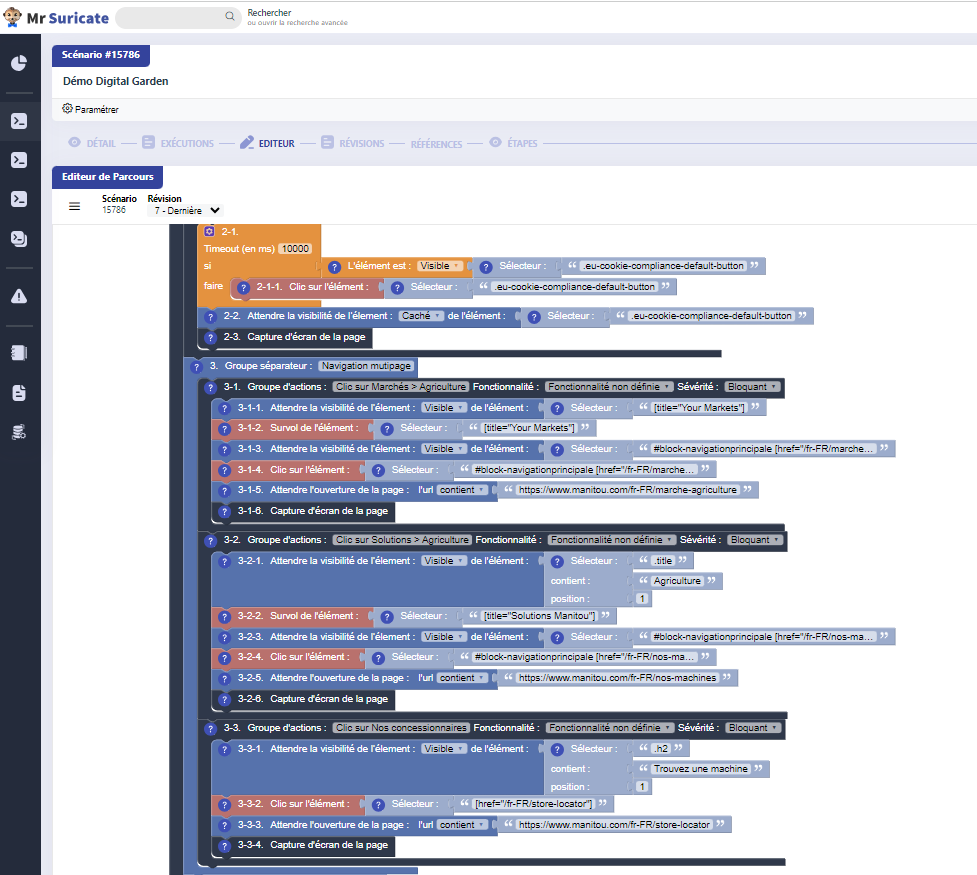 Mr Suricate an innovative test automation solution built using Google Blockly. This combination allows anyone, regardless of their level of technical expertise, to create professional automated tests for various use cases, such as functional, API, performance, accessibility, and SEO testing. In addition, the platform makes it easy to create test scenarios thanks to a navigation feature that directly records actions in Blockly, further simplifying the test setup process.
Integration with Other Tools
Mr Suricate seamlessly into existing CI/CD pipelines, enabling test automation throughout the development cycle. Its advanced alerting features ensure that issues are quickly brought to the attention of the appropriate teams. In addition, the platform integrates effortlessly with project management and testing tools such as XRay, Squash, and Jira, making the process even more seamless and collaborative.
Customer Success Management
 Adopting an automated testing platform is significantly facilitated by the support of a dedicated Customer Success Manager. From scenario design to creation and maintenance, this professional guides you through every step of the process.
Practical Application
Feedback from Mr Suricate
To highlight the benefits of low-code/no-code in the field of automated testing, let’s take the example of one of Mr Suricate clients Mr Suricate B&B Hotels or Edenred. By using our no-code platform, this company cut the time needed to develop automated tests in half and expanded the complexity of the scenarios being tested.
This gain in time and efficiency creates a positive chain reaction:
- Increased Stability
- Faster test deployment facilitates quicker product releases to market.
Consequently, resources can be reallocated to high-value-added activities, thereby increasing profitability and reducing operational costs.
How to Choose the Right No-Code Testing Solution for You
Choosing the best no-code testing solution for your business is an important decision. It is recommended that you choose a platform that is future-oriented and includes artificial intelligence (AI) capabilities. It is also recommended that you pay close attention to the analytics and reporting features of the no-code testing solution, as the future depends on data and clear dashboards.
How to Get Started with No-Code Automated Testing
When considering the implementation of a no-code automated testing platform, it is important to remember that it will not entirely replace all manual testing.
To begin with no-code automated testing, first identify manual tests or those that are challenging to implement. Automating these time-consuming tests will yield the greatest benefit for your testing team.
Next, follow these simple steps:
- Identify the testing processes you wish to automate.
- Choose a no-code platform or tool that suits your needs, such as Mr Suricate.
- Create your test cases using the intuitive visual interface.
- Execute your tests and analyze the results.
Conclusion
Low-code has radically transformed the field of automated testing by paving the way for automation that’s accessible to everyone, thanks to no-code automated testing. Mr Suricate to providing cutting-edge solutions to help businesses boost productivity, reduce costs, and improve the quality of their products. If you’re looking to get started with no-code automated testing, look no further.
Mr Suricate The most comprehensive no-code automated testing tool on the market
Join us and discover how our solution can help you perform automated tests efficiently, without any prior technical expertise.
Automate smartly, automate easily, automate with Mr Suricate.
FAQ
How to choose the right no-code testing solution for you?
Selecting the optimal no-code testing solution for your business is a crucial decision. It is advisable to choose a future-oriented platform that incorporates an Artificial Intelligence (AI) component.
How to get started with no-code automated testing?
When considering the implementation of a no-code automated testing platform, it is important to bear in mind that it will never fully replace all manual tests. To commence with no-code automated testing, first identify manual tests or those that are challenging to implement.
Further Reading
- Facilitate career transition with a crisis-resilient, Low-Code automated testing SaaS solution adapted for non-technical profiles
- The Ultimate Guide to Automated Testing & QA: Strategies, Tools, and Best Practices
- Quality Audit: How Automated Testing Facilitates Compliance (ISO, RGAA, GDPR, etc.)
- Integration with your test management tools
- Test Reporting and Analytics
- No-Code Test Automation
See also: Multi-browser/cross-browser testing | The complete guide.